
What Closed-Cell Spray Foam Actually Costs in Colorado
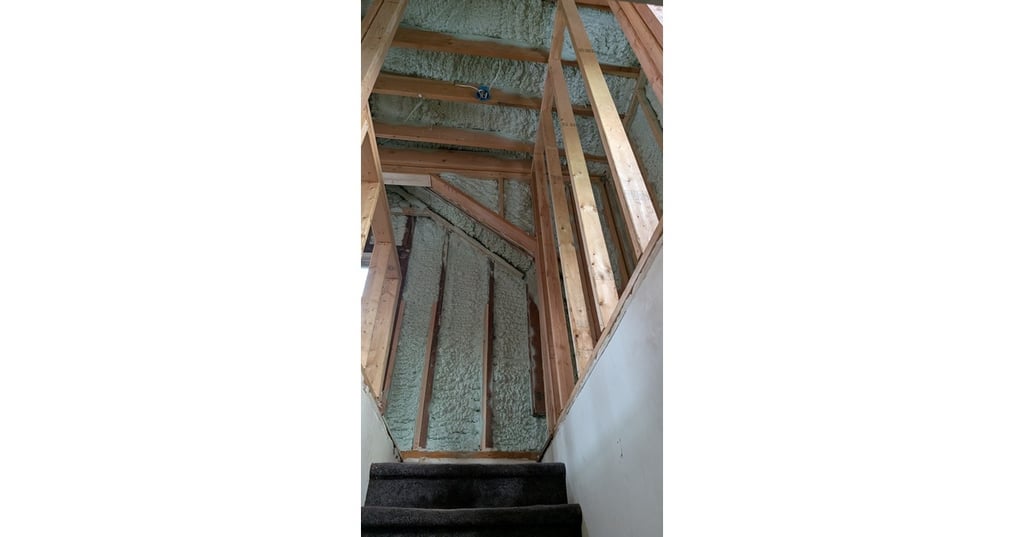
Closed-cell spray foam from Koala Insulation of Boulder costs $0.90 to $1.35 and up per board foot, and most residential jobs land between $1.20 and $1.35 per board foot. A board foot is one square foot of surface at one inch of depth. Our average spray foam job runs about $5,500, our minimum job is $1,250, and a 1,000 square foot roof deck sprayed to R-60 comes in around $10,530.
That’s the answer. The rest of this guide covers why foam is priced by volume, the depth each application needs, the framing limits that cap what an older Colorado house can hold, the Boulder County conditions that make closed cell worth its price, and the jobs we turn down. If you already know you want a scoped number, our spray foam insulation service starts with an assessment of the assembly, and the Koala Insulation of Boulder location page covers the Boulder County and Front Range communities we serve.
Closed-cell spray foam prices at a glance
Ready to start your insulation project?
Item, Price, Unit
Closed-cell spray foam, $0.90 to $1.35 and up, Per board foot
Typical residential closed-cell rate, $1.20 to $1.35, Per board foot
Open-cell spray foam, $0.25 to $0.45, Per board foot
DC-315 ignition barrier over exposed foam, About $1.00, Per square foot of surface
Minimum spray foam job, $1,250, Per job
Average spray foam job, About $5,500, Per job, varies by scope
1,000 sq ft roof deck to R-60 (8,100 board feet at $1.30), About $10,530, Example job
Spray foam removal, 5 to 8 times the cost of new foam, Quoted per job
The rate moves with volume. A large, open, repeatable area sits toward the bottom of the range. A small or cut-up scope sits toward the top.
Why we price by the board foot
Foam is a volume product. The chemicals in the drum don’t care how big your wall is. They care how many cubic inches they have to fill.
So two jobs with the same square footage can be thousands of dollars apart. Spraying 1,000 square feet of wall to R-21 takes about 2,850 board feet. Spraying 1,000 square feet of roof deck to R-60 takes about 8,100. Same footprint, nearly three times the material.
Pricing by the board foot ties your number to the thing that actually costs money. It also gives you something to measure. Depth is the proxy for R-value, and depth can be checked with a probe.
Why per-square-foot answers are wrong
Most cost numbers you find online quote spray foam per square foot of floor or wall. That’s a simplification at best. It hides the single biggest variable.
A per-square-foot quote only makes sense if you know what depth it assumes. Ask. If the answer is vague, the contractor is either guessing or planning to spray to whatever depth fits the price.
The other common mistake is comparing closed cell to open cell on price alone. Open cell is a fraction of the cost per board foot. It is also a different product with a different job, covered below.
Check the math yourself
You need three things: the area, the target R-value, and the rated R-value per inch of the product. The closed-cell foam we install is rated at R-7.4 per inch.
- Divide the target R-value by 7.4. That’s the depth in inches.
- Multiply the depth by the square footage. That’s board feet.
- Multiply board feet by the rate on your quote.
Application, Target R-value, Closed-cell depth, Board feet per 1,000 sq ft
Exterior walls, R-21, About 2.85 inches, About 2,850
Rim joists, R-21, About 2.85 inches, About 2,850
Roof deck and cathedral ceilings, R-60, About 8.1 inches, About 8,100
Worked example, roof deck: 60 divided by 7.4 is about 8.1 inches. 1,000 square feet times 8.1 is 8,100 board feet. At $1.30 that’s about $10,530.
Worked example, average job: our average job of about $5,500 is roughly 4,400 board feet at $1.25. That could be a large wall area sprayed shallow or a small roofline sprayed deep. Square footage alone won’t tell you which.
What decides where your job lands in the range
– Volume. More board feet usually means a lower rate.
– Depth. Roof decks need nearly three times the foam of walls.
– Access. Tight crawl spaces, overhead work, and cut-up attics take longer.
– Exposure. Foam that stays visible needs an ignition barrier, priced per square foot.
– Existing material. Old insulation on a ceiling plane under a new conditioned attic usually comes out as its own line.
– Small scopes. A single rim joist run often falls under the $1,250 minimum, because the rig, crew, and setup cost the same either way.
Framing limits in Boulder County housing
We aim to leave at least half an inch of stud face showing above the cured foam. Drywall needs to land on wood, and the framing should stay readable for whoever opens that wall later. If a cavity has to be filled completely, we can do it, but it costs more because the overspray has to be cut and scraped flush.
That half inch sets a hard ceiling on what a cavity can hold.
Framing, Cavity depth, Max foam with half-inch gap, Approximate max R-value
2×4 wall, 3.5 inches, 3 inches, About R-22
2×6 wall, 5.5 inches, 5 inches, About R-37
2×8 rafter, 7.25 inches, 6.75 inches, About R-50
2×10 rafter, 9.25 inches, 8.75 inches, About R-64
R-21 fits in a 2×4 wall with a little margin. R-60 fits in a 2×10 rafter. It does not fit in a 2×8 rafter with closed cell, no matter who sprays it.
On a retrofit cathedral ceiling with 2×8 rafters, the honest options are to work within what the framing allows, or to add depth with continuous insulation above the deck during a re-roof. We’ll put the maximum achievable R-value in writing. We won’t pretend it’s code.
Boulder County conditions that make closed cell worth it
Boulder sits at roughly 5,300 feet (USGS) in Climate Zone 5B, which the International Energy Conservation Code classifies as cold and dry. Winters are long. Summers bring hot attics. Chinook winds push air through every gap in an envelope.
The housing stock matters most. Boulder, Golden, Arvada, Westminster, and the older cores of Lafayette and Louisville are full of 2×4 exterior walls. Closed cell at R-7.4 per inch is one of the few products that gets a 3.5-inch cavity to R-21 while also air sealing it. That’s the specific problem it solves here.
Ice dams are the other one. Heat leaking up through a ceiling warms the roof deck, melts snow, and the melt refreezes at the cold eaves. When foam moves to the roof deck in a properly sealed conditioned attic, that warm air path to the underside of the roof is cut off. It also puts attic ductwork inside conditioned space, out of air that swings from below zero to well over 100 degrees.
Open cell: where it fits, and where it doesn’t
Open cell runs $0.25 to $0.45 per board foot. It’s the first thing homeowners notice when they compare prices.
It gives up a lot of R-value per inch, and it is not a vapor retarder. In an assembly that can see moisture, that difference matters more than the price. We use open cell mostly for sound: floors between levels, media rooms, shared walls. If quiet is the goal, it’s the better buy and we’ll say so.
On new construction and gut remodels, a common budget path in a 2×6 wall is flash and batt: a layer of closed cell against the sheathing, then batt insulation filling the rest of the cavity. You get the air seal and moisture control where it has to be and save money on the remaining depth.
Ignition barrier and exposed foam
Foam left exposed to an interior space needs an ignition barrier. Koala Insulation of Boulder is a certified NFPA DC-315 ignition barrier installer, and we always coat residential spray foam that is left without drywall over it.
It runs about $1.00 per square foot. That’s per square foot of surface, not per board foot, because it’s a coating. A 1,000 square foot exposed garage ceiling adds about $1,000. Garages, mechanical rooms, and shop spaces are where it comes up. An improperly applied barrier is worse than an obvious missing one, because it looks compliant.
What a complete job includes, and where cheap quotes cut corners
A complete closed-cell job from Koala Insulation includes:
– An assessment of the assembly, the ventilation strategy, and where moisture goes, before a number is written
– HVAC shut down, belongings protected, and negative-pressure ventilation set up
– A calibrated 1:1 ratio of A-side and B-side, test sprayed before the work starts
– Even lifts, with depth measured as we go
– Trimming after cure, an inspection checklist against your approved plan, and cleanup
Cheap quotes save money in places you can’t see after the drywall goes up. No ratio check. Lifts sprayed too thick. And short depth, which is the expensive one. One of our customers found out after a re-roof that a previous contractor had charged for 3 inches and applied 1.5.
Retrofit insulation work in Boulder city and county isn’t permitted, so no inspector measures it. Ask for depth documentation. On retrofits, nobody else will check.
Questions to ask before you book
– How many board feet is this quote, and at what rate?
– What target R-value and depth for each area?
– What is the product’s rated R-value per inch? Can I see the spec sheet?
– How will installed depth be documented?
– Will you leave stud face showing, or fill the cavity flush?
– Is an ignition barrier needed, and is it in the number?
– Does existing insulation need to come out first?
– For a roof deck, what happens to the attic vents?
Cold weather, cure, and re-entry
Colorado weather lets us spray most days of the year. Our foam is stored in a heated warehouse. On cold mornings we may start later or the job may run longer, so the substrate and the mix stay in spec. That hasn’t historically disrupted schedules.
We recommend staying out of the house for 24 hours after spraying, and we shut down your HVAC during the install. Cure time and safe re-entry are not the same thing. If you choose to come back sooner than 24 hours, that choice is documented and you sign off on it.
When we say no
We turn down more foam work than you’d expect from a company that sells it.
– When a cheaper product does the job. If blown-in insulation with proper air sealing gets you an equal result for a fraction of the cost, that’s the recommendation.
– Foam on the attic floor. We never spray foam on the floor of a standard pitched attic designed to be ventilated. That isn’t how the assembly works.
– Closed cell on a roof deck with the vents left open. Foaming the deck makes it an unvented assembly. Leaving the ventilation in place gets you the drawbacks of both.
– Open cell where moisture will be a problem. Cheaper today, a wet assembly later.
– Partial foam removal. We do remove old spray foam, at 5 to 8 times the cost of new foam, but only the whole area, and the owner signs a release of liability on the material being removed.
Why Koala Insulation of Boulder
We quote in board feet, depth, and R-value per inch, and we write down the framing limits before the rig arrives. We’re a certified NFPA DC-315 ignition barrier installer. Three certified BPI analysts on staff assess how the whole house performs, not just the cavity in front of them. And when foam is the wrong call for your assembly, we tell you, even if that means a smaller job or no job.
Frequently asked questions
What is a board foot of spray foam?
A board foot is one square foot of surface covered one inch deep. Spraying 100 square feet at 3 inches deep is 300 board feet, and closed-cell foam is priced per board foot.
How many inches of closed-cell foam does an R-21 wall need?
At R-7.4 per inch, R-21 takes about 2.85 inches of closed-cell foam. That’s roughly 2,850 board feet for every 1,000 square feet of wall.
Can a 2×4 wall reach R-30 with closed-cell foam?
No. A 2×4 wall holds about 3 inches of foam with a half inch of stud face showing, which caps it near R-22. R-30 needs 2×6 framing or continuous insulation outside the studs.
Is open-cell foam a cheaper substitute for closed cell in Colorado?
Not usually. Open cell costs $0.25 to $0.45 per board foot, but it has less R-value per inch and doesn’t control vapor, so Koala Insulation uses it mostly for sound control.
What is the smallest spray foam job Koala Insulation of Boulder takes on?
The minimum spray foam job is $1,250. Small scopes like a single rim joist run often fall under that floor because setup costs the same regardless of size.
Does exposed spray foam in a garage need a coating?
Yes. Foam left without drywall needs an ignition barrier, and Koala Insulation applies DC-315 at about $1.00 per square foot of surface.
Will Koala Insulation fill a stud cavity flush with foam?
Our standard is to leave at least half an inch of stud face showing. If a cavity must be filled completely, we can do it at a higher price to cover cutting and scraping the overspray.
Can closed-cell foam be sprayed on a cold winter day in Boulder?
Most days, yes. Our foam is stored in a heated warehouse, and cold weather may push back a start time or lengthen the job rather than cancel it.
How do I verify the foam depth I paid for on a retrofit?
Ask your contractor for depth measurements by area and the product spec sheet. Retrofit insulation isn’t permitted in Boulder city or county, so no inspector checks it for you.
Does Koala Insulation remove old spray foam?
Yes, at 5 to 8 times the cost of installing new foam. We remove the full area rather than partial sections, and the owner signs a release of liability on the foam being removed.
Find Your Location



Get a quote