
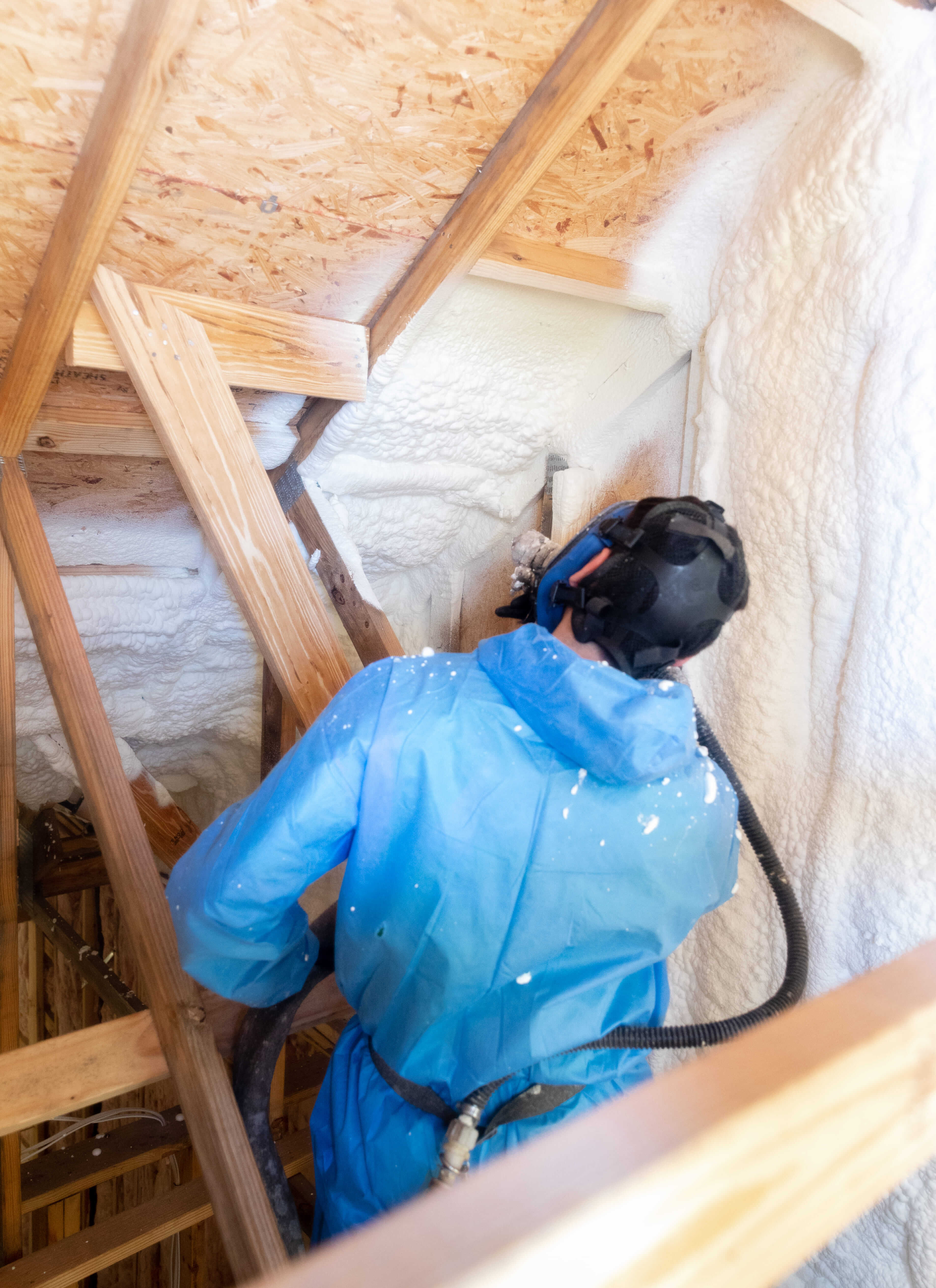
Spray foam insulation is an exceptional thermal barrier in tight spaces, but not all products are the same. Open-cell and closed-cell spray foam have unique benefits in specific applications, but it’s not always easy to choose the most effective option for your space.
If you’re already leaning toward spray foam, learn a bit more about the difference between open-cell foam and closed-cell foam insulation and where each material performs best.
Open-Cell vs. Closed-Cell Foam Insulation
The two main types of spray foam insulation, open- and closed-cell materials, offer excellent energy efficiency and air sealing properties. Both materials are made from an isocyanate and polyol resin blend to create a sprayable polyurethane foam that expands and hardens quickly when installed. But there are several differences to keep in mind, including R-value, cost, expansion rate, and soundproofing. Here’s a full description of each product, followed by a quick-reference comparison chart.
What Is Closed-Cell Insulation?
Closed-cell foam insulation is rigid, dense, and solid enough to enhance a home’s structural integrity. Closed-cell insulation’s density offers high thermal and air resistance, which is ideally suited for climates and spaces with wide temperature ranges.
Top 3 Benefits of Closed-Cell Foam Insulation
R-value: The R-value of closed-cell foam per inch is the highest of any material on the market.
Moisture resistance: Closed-cell foam has low moisture and vapor permeability, which means it prevents moisture from leaking into the building environment. This is especially important in regions with high humidity.
Air barrier: Few insulation materials match closed-cell foam’s ability to prevent air leakage, which significantly improves energy efficiency.
Where to Use Closed-Cell Spray Foam
In many cases, closed-cell foam’s characteristics make it an ideal fit for exterior wall cavities, roofs, basements, and other below-grade building elements where moisture and structural integrity are top considerations.
What Is Open-Cell Insulation?
Open-cell insulation is soft, flexible, and less dense than closed-cell insulation. Its name is based on its cellular structure, which isn’t completely sealed, giving it a slightly sponge-like feel. The structure also allows it to expand more (and more rapidly) than closed-cell foam, making it more effective at filling hard-to-reach areas.
Top 3 Benefits of Open Cell Insulation
Affordability: While the R-value of open-cell insulation is lower than that of closed-cell insulation (3.5 to 5 per inch), it is more affordable, making it a great option for many homeowners.
Expansion: The voluminous, rapid expansion of open-cell foam makes it ideal for filling tight spaces, especially attics and crawl spaces.
Soundproofing: Open-cell foam offers excellent acoustic sound absorption thanks to its porous cell structure.
Where to Use Open-Cell Insulation Spray Foam
Open-cell foam is a great choice for areas with low moisture levels, such as interior walls, many attics, and other inaccessible areas. That means it’s not a good option for basements, and its lower R-value means it may not be a cost-effective option for exterior walls, which require a higher thermal barrier in many areas.
What Is Better: Closed-Cell or Open-Cell Insulation?
The best option depends on several factors, including your region’s insulation guidelines, the part of the home that needs insulation, and your budget. Your local Koala team will provide expert recommendations to help you choose between open-cell and closed-cell insulation, or we’ll suggest a better material to suit your needs.
Here’s a quick comparison of the advantages of each material:
| Feature |
Open-Cell Spray Foam |
Closed-Cell Spray Foam |
| Cell Structure |
Cells are not fully encapsulated; they are open, creating air pockets. The texture is soft and spongy. |
Cells are fully encapsulated and tightly packed. The texture is rigid and dense. |
| Density | Low density (approx. 0.5 lb/ft³) | High density (approx. 1.75 – 2.0 lb/ft³) |
| R-Value per Inch | Lower R-value (approx. R-3.5 to R-3.8 per inch)
It often requires a thick application to reach the desired R-value. |
Higher R-value (approx. R-6.0 to R-7.0 per inch) It provides superior thermal resistance in less space. |
| Expansion Rate | High; expands significantly (up to 100x its liquid volume) | Low; expands less (approx. 25-35x its liquid volume) |
| Moisture/Vapor |
Permeable It allows vapor to pass through and can absorb water. |
Highly resistant to water It acts as a vapor barrier at sufficient thickness (usually 1.5-2 inches). |
| Structural Support | Does not add structural strength | Adds structural strength to walls and roofs |
| Air Barrier | Excellent air barrier when properly installed at full thickness | Excellent air barrier |
| Sound Dampening |
Excellent dampening due to softness and porousness |
Moderate dampening due to rigidity |
| Cost | Generally less expensive per square foot due to higher yield (less material needed for volume) | Generally more expensive due to higher material density and lower yield |
| Typical Use | Interior walls, ceilings, and attics (especially for sound reduction) | Exterior walls, crawl spaces, basements, commercial roofs, or areas where moisture resistance and high R-value in a thin space are critical |
Is Open- or Closed-Cell Foam Insulation Right for You?
Make an informed decision with expert recommendations from our highly trained insulation experts. We bring national resources and local expertise to every residential and commercial insulation project, delivering lasting results and delighting our customers. Get all your insulation questions answered by contacting the Koala Insulation location nearest you.
Related
Articles
Find Your Location



Get a quote