
What Crawl Space Encapsulation Actually Costs in Boulder County
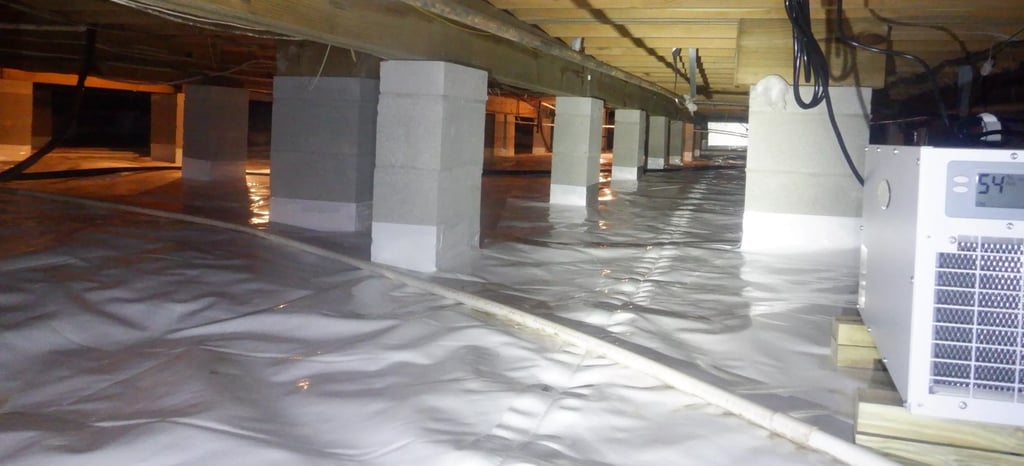
Nobody enjoys this purchase. Nobody has been looking forward to encapsulating their crawl space. It’s a space you’ve been in once, it smelled bad, and now someone wants several thousand dollars to fix a part of the house you’ll never look at again.
So the least we can do is tell you what it costs and why, instead of making you call three companies to find out.
Here are our actual numbers for Boulder County, followed by an explanation of what moves them.
Ready to start your insulation project?
The pricing
Vapor barrier only — $1.50 per square foot. A typical Boulder-area crawl space runs about 800 square feet, which puts this job around $1,250.
Full encapsulation — $4.00 to $5.00 per square foot. Typical job: about $3,500.
French drain or sump system — $100 per linear foot. This is drainage work, priced separately, and it happens before encapsulation rather than instead of it.
Dehumidifier — $2,200 installed. Often unnecessary in Colorado. More on that below.
Most complete projects land between $3,000 and $4,275.
The number that drives everything: square footage of the floor
This is the part homeowners get wrong most often, and it’s why quotes vary so much between houses that look similar from the street.
Crawl space pricing scales with the square footage of the crawl space floor, because the vapor barrier covers the ground. It does not scale with the size of your house. A 3,000 square foot home built on a slab with a small mechanical crawl space is a smaller job than a 1,400 square foot ranch sitting entirely over a crawl space.
Before you compare two bids, find out what square footage each contractor measured. If they differ, one of them didn’t measure.
Why the range between $1.50 and $5.00 per square foot is so wide
Because they’re genuinely different jobs.
Vapor barrier only is exactly what it sounds like: 20-mil reinforced barrier laid across the ground, seams overlapped and sealed, run up the foundation walls and mechanically fastened. The crawl space stays vented. You’ve addressed ground moisture and nothing else.
Full encapsulation adds sealing the vents, sealing and insulating the foundation walls, and turning the crawl space into a closed, semi-conditioned part of the building envelope. More material, more labor, and a different building science outcome.
The gap between them isn’t upsell. It’s whether you’re stopping moisture or also capturing an energy benefit.
Which one do you actually need?
Here’s the part that’s specific to Colorado, and it’s the reason we’d steer a lot of Boulder County homeowners toward the cheaper option.
Most national content about crawl spaces describes humid outdoor air entering a cool crawl space and condensing on surfaces. If that were the mechanism here, you’d expect crawl space complaints to peak in July.
They don’t. In Boulder County the calls come in fall, winter and early spring. That timing points at ground moisture — water moving up through the soil — not at outdoor humidity. Colorado’s outdoor air is dry nearly year-round.
Which means for a lot of homes, covering the ground is the fix. If your crawl space is dry, the foundation is sound, and there’s no efflorescence on the walls, a properly installed 20-mil barrier at around $1,250 may solve your problem completely. You don’t need to spend $3,500.
Full encapsulation earns its price when you’re also after the energy and comfort benefit — cold floors above the crawl space, an unconditioned space full of ductwork, or a plan to bring the crawl space inside the thermal envelope.
Ask any contractor bidding your job which outcome they’re pricing. If they only offer one option, they’re not pricing your house, they’re pricing their standard package.
Where the cheap bids get cheap
If a bid comes in dramatically under everyone else’s, it’s almost always one of these four.
Six-mil instead of 20-mil. This is the big one. Six-mil sheeting is hardware store plastic. It tears when a plumber crawls over it, tears at the fasteners, and tears at the seams. Two years later it’s shredded and you’re back where you started, except now there’s plastic in the way. Twenty-mil reinforced barrier takes foot traffic and stays put. Ask every bidder for the mil thickness in writing.
No removal. Old fallen insulation, contaminated material, and rodent debris have to come out and get hauled away. Leaving it under new plastic is cheaper for the contractor and worse for you.
No wall attachment. Barrier that just lies on the dirt, not run up the foundation walls and mechanically fastened, will migrate and expose the perimeter — which is where a lot of the moisture is.
No seam sealing. Overlapped but unsealed seams are a partial job priced as a complete one.
Those four items are most of the difference between a $1,250 job done right and a $700 job you’ll pay for twice.
About that dehumidifier
A dehumidifier is $2,200 installed and a lot of crawl space bids include one by default.
A dehumidifier removes moisture that’s already in the air of the crawl space. It does not stop water coming up through the ground. If the barrier is doing its job in a dry climate like ours, a dehumidifier is frequently unnecessary — and if the barrier isn’t doing its job, the dehumidifier is running constantly against a source it can’t defeat.
There are crawl spaces that need one. But if a contractor leads with the dehumidifier before they’ve talked about the ground, they’re selling equipment rather than solving the problem.
When to spend money somewhere else first
Some crawl space problems aren’t crawl space problems.
Standing water or active intrusion. Encapsulating a crawl space that floods is putting a lid on it. Water gets addressed first — sometimes with a $100-per-linear-foot drain, and sometimes with $200 of downspout extensions and regrading, which costs almost nothing and fixes it entirely. We’ve told homeowners exactly that and left without a job.
White chalky residue on the foundation walls. That’s efflorescence — mineral deposits left behind as water passes through masonry and evaporates. It’s proof of water movement through the wall. Barrier over the ground doesn’t address it.
Soft wood near grade. Rot in joists or the sill plate is a carpentry job before it’s an insulation job.
Paying for it
If cost is what’s stalling the project, there are more options than there were two years ago.
We’re an authorized contractor for ClearPath On-Bill, a program administered by the Collective Clean Energy Fund in partnership with Xcel Energy, which lets qualifying homeowners pay nothing upfront and repay on their monthly Xcel bill. We’re also an authorized Colorado RENU Loan contractor, available statewide regardless of utility, and conventional home improvement financing is available too.
Rates, terms and eligibility are set by the program administrators rather than by us. There’s no minimum project size on ClearPath, so even a $1,250 vapor barrier job can go on it.
What to do with all this
Get two or three bids. For each one, ask four questions:
What square footage did you measure?
What mil thickness is the barrier?
Is removal and haul-away included?
Is the barrier fastened to the foundation walls, and are the seams sealed?
Those four answers will tell you more than the price will.
If you’re in Boulder County and want a written scope with line-item pricing, we’ll go into the crawl space, take photographs, and give you one. And if what you actually need is a drainage contractor, we’ll tell you that instead.
Koala Insulation of Boulder 1435 Yarmouth Ave Ste 103, Boulder CO 80304 720-738-7825
Pricing reflects typical Boulder County projects and is subject to site conditions, crawl space size and access. Final pricing is provided in a written scope following an on-site assessment. ClearPath On-Bill and Colorado RENU Loan terms and eligibility are set by the program administrators; Koala Insulation of Boulder does not originate credit or determine approval.
Find Your Location



Get a quote