
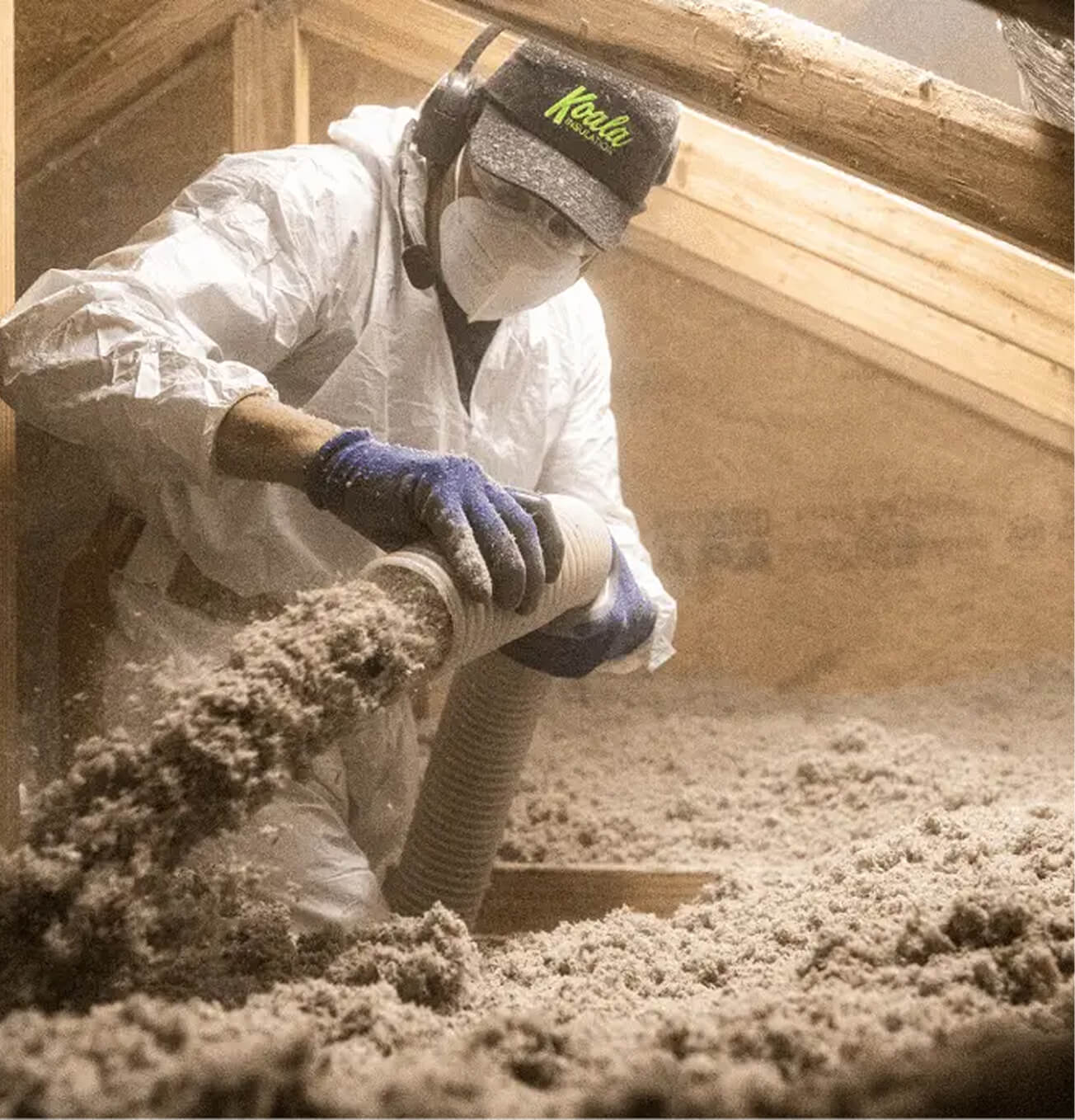

Blocks Conductive Heat Loss: By thickening the barrier between living space and attic, blown-in insulation slows the heat that would otherwise pass through the ceilings and walls of your Delaware Valley home as outdoor conditions swing.
Local Blown-In Insulation Services in the Delaware Valley
Let Our Insulation Experts Show You The Many Benefits Of Our High Performance Insulation.
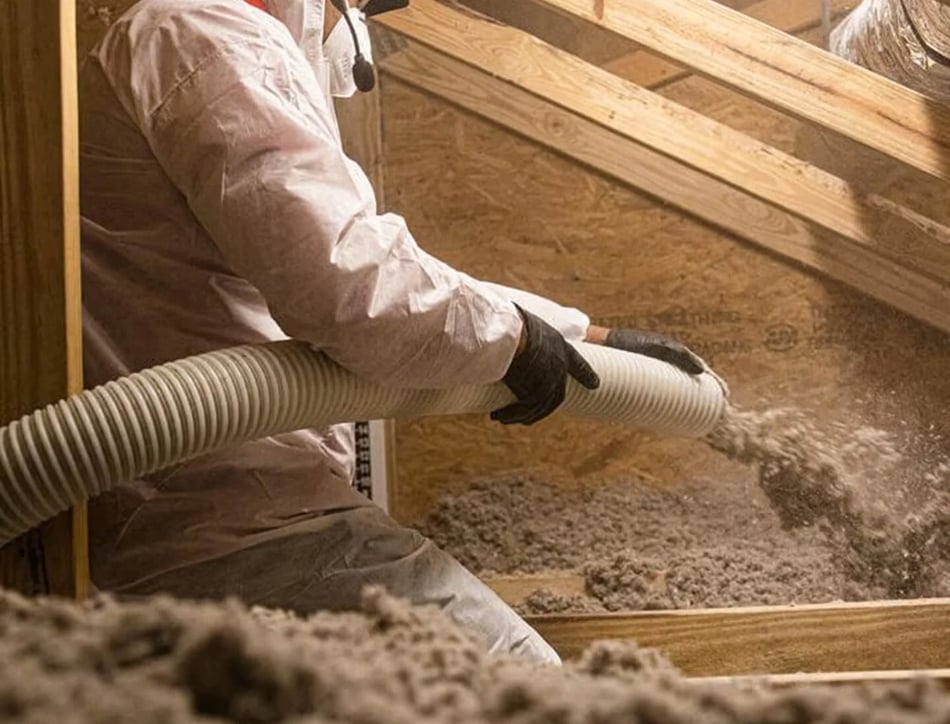
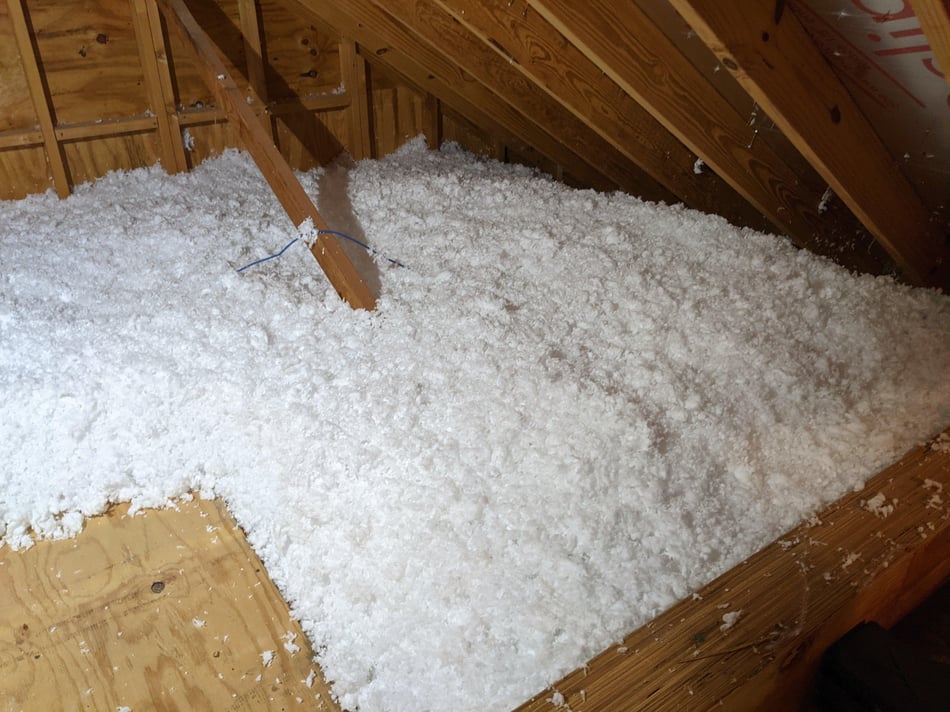
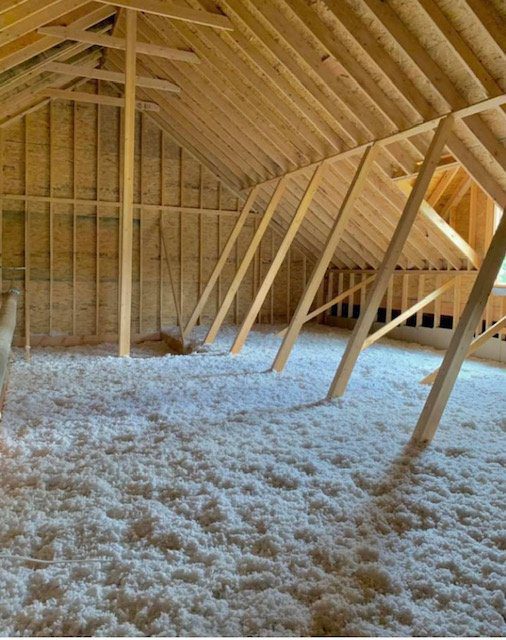
When it comes to boosting comfort in the Delaware Valley, blown-in insulation is hard to beat for speed and value. Our team “blows” loose-fill material into attics and enclosed cavities through a hose, forming a deep thermal blanket that conforms to every corner and framing gap.
If your insulation is thin, patchy, or decades old, Koala Insulation of Delaware Valley can bring it up to modern standards.
Get a Free Estimate


Trusted
Blown-In Insulation Pros in the Delaware Valley

The Delaware Valley’s hot, humid summers and cold winters can make your home feel uncomfortable and your HVAC system work overtime. And because insulation settles and standards have risen, many local homes have far less attic coverage than current guidelines recommend.
Where blown-in insulation shines:
Attic floors to quickly boost your R-value to modern standards.
Knee walls & sloped ceilings for those hard-to-reach areas.
Wall cavities in some retrofit situations, following industry best practices.
A Superior
Your Thermal Comfort Upgrade
Delaware Valley homeowners and businesses choose blown-in insulation because it upgrades comfort and efficiency in a single visit. Installed as a continuous layer over the attic floor or packed into cavities, loose-fill performs like conventional insulation while going in faster and covering more evenly, even over existing material.
These capabilities define the insulation type:
Cuts Air Leakage: Paired with our targeted air sealing, a blown-in blanket helps close off the small pathways around framing, wiring, and plumbing where conditioned air leaks out of your Delaware Valley home and outdoor air sneaks in.
Limits Condensation: Better attic R-value plus preserved ventilation means fewer cold surfaces where moisture can condense, protecting both your Delaware Valley home and the insulation itself.
Advantages Of
Blown-In Insulation in the Delaware Valley
Between cold winters and seasonal extremes, homes in the Delaware Valley work hard to stay comfortable. Blown-in insulation helps by installing quickly, topping off existing layers, and supporting lower energy costs with year-round comfort. Additional advantages include:

Improved Air Quality
Pair blown-in insulation with attic air sealing and fewer outdoor particles find their way inside. Sealing the gaps around light fixtures, plumbing chases, and the attic hatch limits the dusty attic air that would otherwise drift into living spaces in the Delaware Valley.

Water & Fire Resistance
The blown-in products we install are designed with fire safety in mind. Proper installation around recessed lights, chimneys, and other heat sources is critical, and our team follows local codes and manufacturer guidelines to help keep your Delaware Valley home safe.

Pest and Wildlife Protection
Worried about unwanted attic guests? Cellulose is the one blown-in material treated with pest-deterrent additives, and pairing it with thorough air sealing helps keep insects and critters out of attics in the Delaware Valley.

Soundproofing
Noise reduction is a welcome bonus for Delaware Valley homeowners: the dense loose-fill layer soaks up outside sounds and dampens noise moving between levels, from street traffic to kids playing overhead.

Environmentally Friendly
Made largely from recycled materials, blown-in insulation is one of the greenest upgrades your Delaware Valley home can get. It cuts the energy needed for heating and cooling (by up to 40% in some studies), lowering both utility bills and carbon footprint.
The Delaware Valley’s Easy 4-Step
Blown-In Insulation Process

Free Home Efficiency Assessment
It all starts with a free visit: our team evaluates your current insulation levels and overall efficiency so recommendations fit your Delaware Valley home, not a template.
- Protect & Prep the SpaceFirst we prepare your Delaware Valley home properly: floor and walkway protection goes down, safe attic access goes up, and depth rulers are positioned across the attic so final coverage can be measured everywhere. Eave baffles are installed as needed to protect soffit airflow.
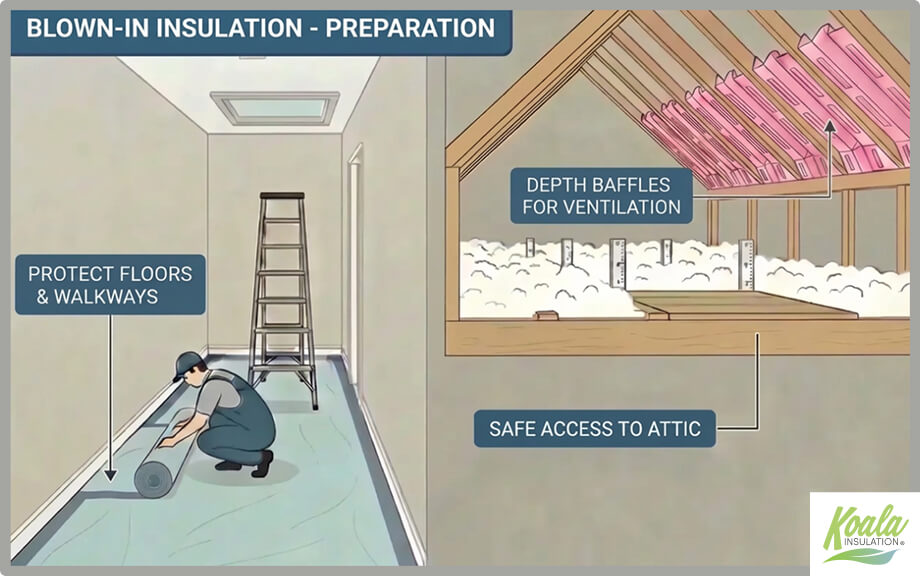
Koala Difference: We carefully protect your home and prepare the area so your new insulation performs as it should, and your Delaware Valley home is not left covered in dust when we are done.
- Seal the Leaks FirstThis is the step most installers skip: guided by thermography leak detection, we seal plumbing, wiring, and recessed-light penetrations plus the attic access in the Delaware Valley, so the insulation above works with a tight ceiling below.
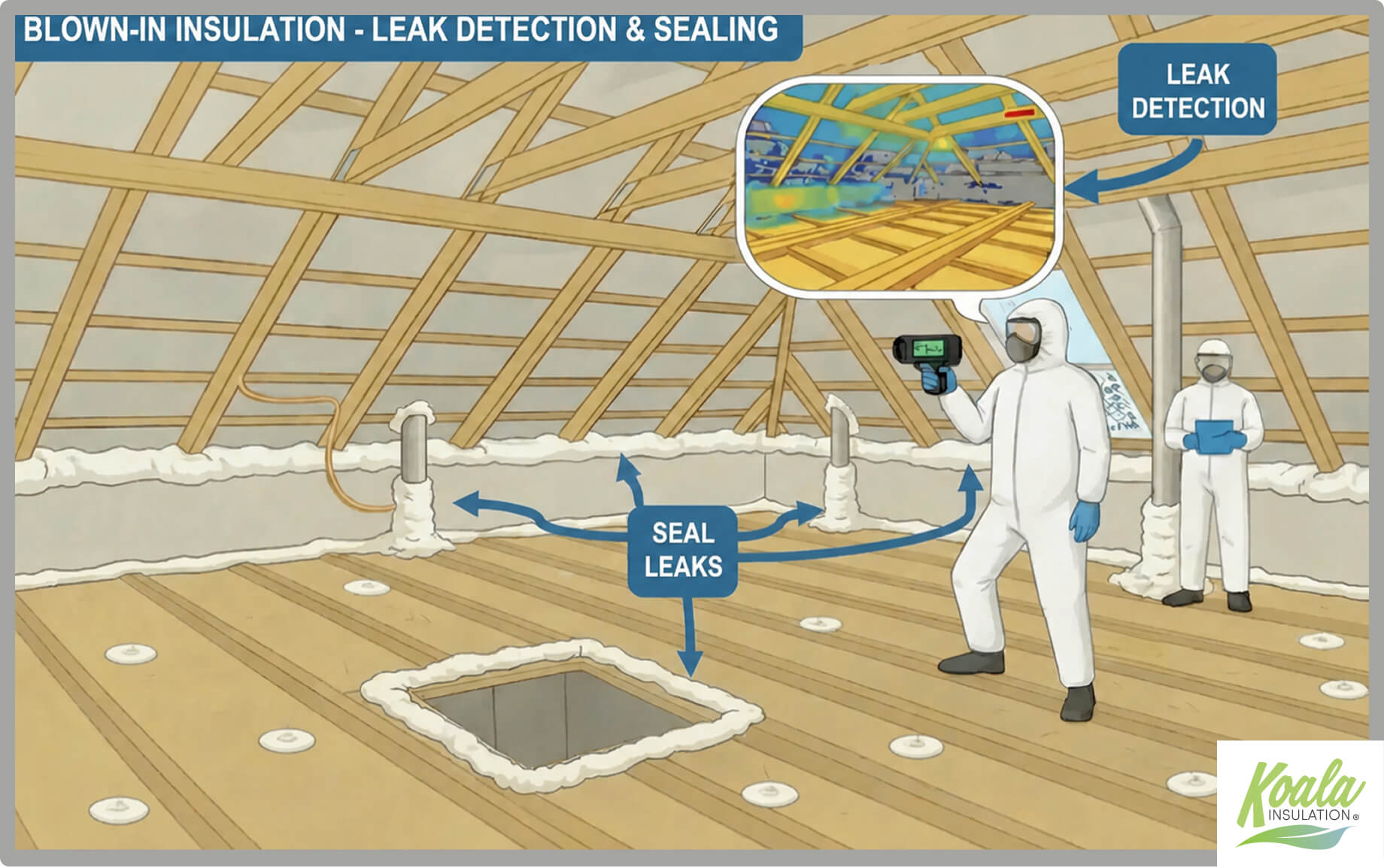
Koala Difference: We do not just “add fluff.” By combining blown-in insulation with strategic air sealing, we help you get more comfort and value out of every inch we install in the Delaware Valley.
- Blow In the InsulationInstallation day moves fast: material flows through the hose while our installers distribute it to the planned depth, fill awkward corners, and confirm against depth markers until every section of the attic in your Delaware Valley home hits the target level.
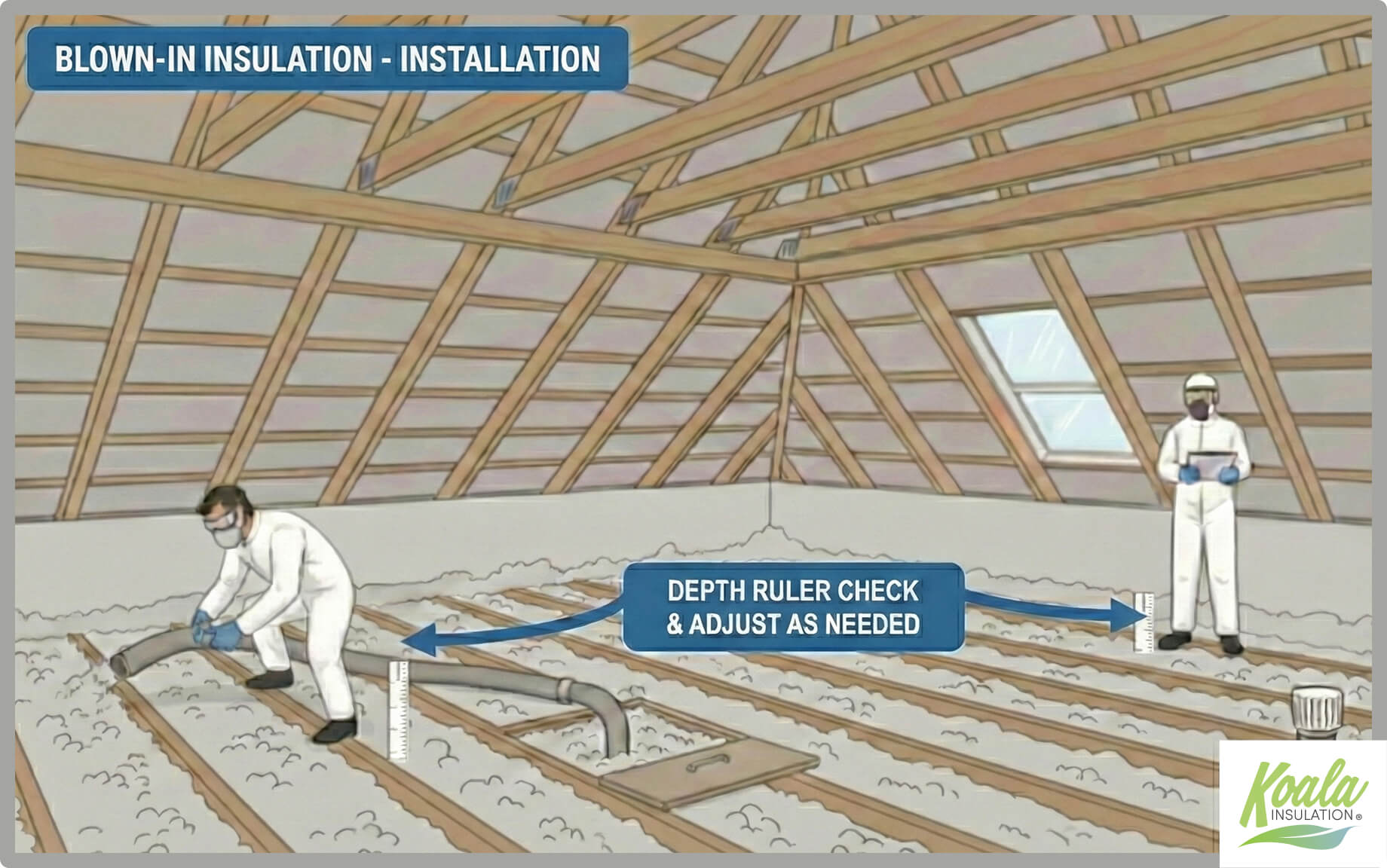
Koala Difference: Coverage is everything. We take the time to verify depth and consistency so your Delaware Valley home is not left with “thin spots” that reduce performance.
- Cleanup, Photos & Walkthrough
Cleanup is part of the job, not an afterthought in the Delaware Valley. We vacuum and tidy the space, remove every piece of equipment, confirm the attic access seals properly, then review the results with you, photos included when available.
Koala Difference: Consider us a long-term resource: future questions, maintenance advice, and guidance on rebates or tax credits that may apply to your project in the Delaware Valley.
Get a Quote
Your comfort upgrade starts with one visit. Schedule your free assessment with Koala Insulation of Delaware Valley, the blown-in insulation team Delaware Valley homeowners trust!
What to Expect
In 5 Easy Steps
In 5 Easy Steps
What to Expect
In 5 Easy Steps

Schedule Your Free Evaluation
Contact your nearest Koala Insulation Location, recognized as the #1 trusted insulation expert nationwide. We will discuss your needs and schedule an appointment to provide a free evaluation.

Home Efficiency Assessment & Estimate
One of our friendly insulation experts will perform a thorough home efficiency assessment. Your insulation expert will then review the assessment findings, the science behind these findings, and why any changes are needed. Lastly, your insulation expert will provide the best option that fits your home efficiency needs and your budget.

Schedule Your Insulation Service
We will schedule your insulation service for the soonest availability that fits your schedule because we understand that your home insulation is a priority!

Installation
Our team of highly skilled insulation technicians will install your premium insulation solution in as little as two hours. We treat your home like our own and take time to leave it cleaner than it was before.
Post Installation Inspection
Contact your nearest Koala Insulation Location, recognized as the #1 trusted insulation expert nationwide. We will discuss your needs and schedule an appointment to provide a free evaluation.

Enjoy Your Comfortable & Efficient Home
Enjoy a more efficient home with lower energy bills and improved comfort year-round. Enjoy your improved home stress free knowing that Koala Insulation stands behind their work! Reach out to your Koala Insulation team anytime for support.

Benefits

Enhanced Comfort

Energy Savings

Quality Materials

Eco-Friendly Options
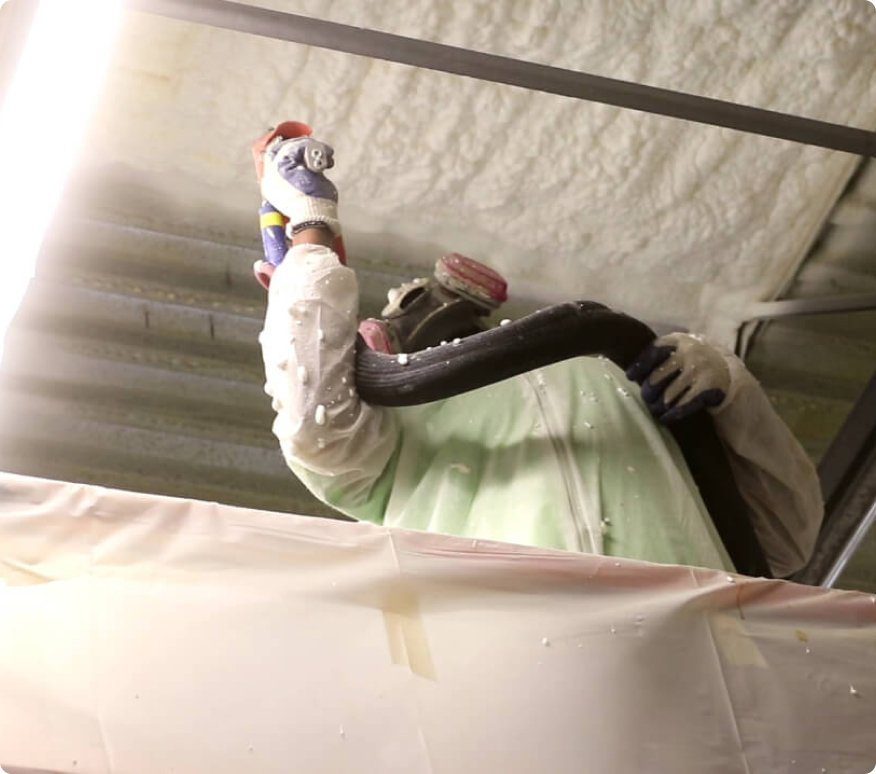
Enhanced Comfort
Stay cozy inside, no matter the weather outside.
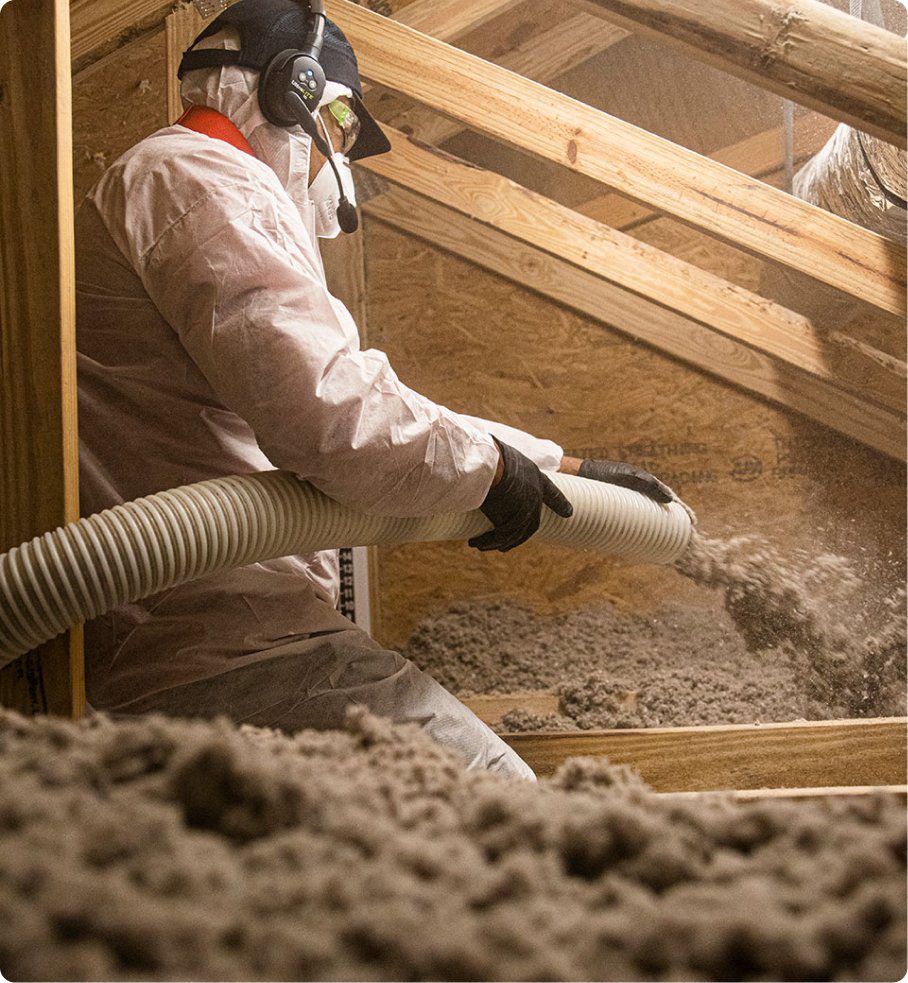
Energy Savings
Save on your energy bills while keeping your home comfy all year.
Reduced Noise
We use top-quality insulation to give you lasting results.
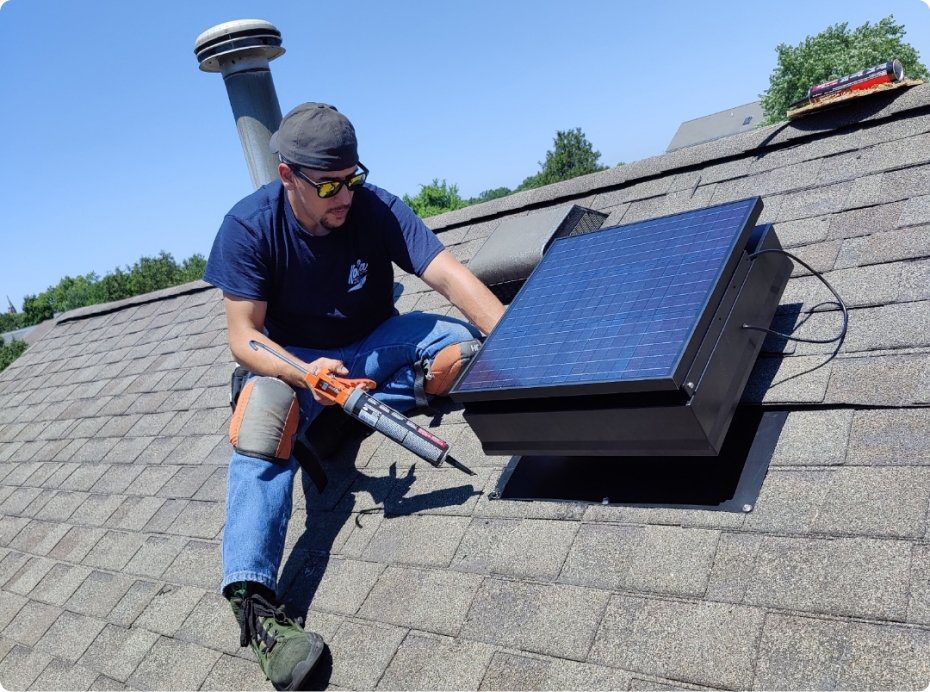
Eco Friendly
Choose insulation that’s better for your home and the planet, such as solar-powered attic fans.
Your Satisfaction is
Our Top Priority
Our favorite reviews come from neighbors. Read what homeowners in the Delaware Valley say about their Koala experience.


Donato
18:43 09 Apr 26
I can’t say enough great things about Koala Insulation! From start to finish, the experience was top-notch. Sal is incredibly professional, honest, and truly cares about the quality of work and customer satisfaction. You can tell he takes a lot of pride in his business.
The technicians were just as impressive—on time, respectful, and extremely knowledgeable. They walked me through the entire process, answered all my questions, and made sure everything was done perfectly. The attention to detail in my attic was outstanding, and they left everything clean when they were done.
Not only does my home feel more comfortable already, but I also have peace of mind knowing the job was done right. If you’re looking for a reliable, hardworking, and trustworthy insulation company, look no further than Koala Insulation. Highly recommend!
The technicians were just as impressive—on time, respectful, and extremely knowledgeable. They walked me through the entire process, answered all my questions, and made sure everything was done perfectly. The attention to detail in my attic was outstanding, and they left everything clean when they were done.
Not only does my home feel more comfortable already, but I also have peace of mind knowing the job was done right. If you’re looking for a reliable, hardworking, and trustworthy insulation company, look no further than Koala Insulation. Highly recommend!

Rosa Tees
17:27 16 Mar 26
This company is the best I have ever dealt with in terms of home repair/jobs. I have had a few projects done in my home (built early 90's) and no company has been better to deal with. Their prices are fair and the quality is unmatched. The professionalism from Sal was stellar and appreciated. They got the job done quickly and efficiently. This past winter was cold and the insulation in my home has made a huge difference, especially in my utility bills and the comfort of my family. Overall, great company to deal with, I highly recommend them.

guangyue he
14:17 31 Dec 25
We found wildlife activities on my attic. We also realized the insulation was just too old, and thus we wanted to replace it. We called several companies for the two services. Koala provided the lowest price that no one can match! Their main service is replacing insulation. But they are willing to help repairing all existing leaks/holes as a side service. The work took only couple hours. The guys were very nice and they kept your floor clean. Even after the work was done, they were willing to come back to check if the repair was successful. Again their main service was replacing insulation. But they were all nice people that kept your problems in mind. You should trust them for the great service! :)

A
00:53 04 Dec 25
I had an outstanding experience with Koala Insulation of the Delaware Valley from start to finish. It's stressful and hard to find quality companies these days so it's very rewarding when it all works out. In this case it worked out very well!
Their entire team made the process easy, transparent, and completely stress free. Dan, the owner, even stopped by personally to make sure everything was on track, which really shows the level of care they put into their work.
Sal handled my estimate and was excellent throughout. He walked me through the job in detail, offered clear options, and never tried to upsell or push anything unnecessary. His pricing was very competitive compared to other companies, and he was honest, responsive, and easy to trust, which made the decision simple for me.
The installation crew was fantastic. They are a solid bunch of guys that are helpful towards each other and it really showed in their work. Chris, Pat, Aaron, Shawn, and Alex were professional, efficient, and clearly take pride in what they do. They kept everything clean, respected my home, explained what they were addressing in the attic, and made sure the insulation was done correctly. I can't say enough good things about that crew.
Chris completed a final walkthrough to confirm everything was perfect, and there were no surprises and no extra charges. It is rare these days to find a company that is this honest, well run, and committed to quality.
I am very glad I chose Koala and I highly recommend them to anyone looking for insulation done the right way at a great value!
Their entire team made the process easy, transparent, and completely stress free. Dan, the owner, even stopped by personally to make sure everything was on track, which really shows the level of care they put into their work.
Sal handled my estimate and was excellent throughout. He walked me through the job in detail, offered clear options, and never tried to upsell or push anything unnecessary. His pricing was very competitive compared to other companies, and he was honest, responsive, and easy to trust, which made the decision simple for me.
The installation crew was fantastic. They are a solid bunch of guys that are helpful towards each other and it really showed in their work. Chris, Pat, Aaron, Shawn, and Alex were professional, efficient, and clearly take pride in what they do. They kept everything clean, respected my home, explained what they were addressing in the attic, and made sure the insulation was done correctly. I can't say enough good things about that crew.
Chris completed a final walkthrough to confirm everything was perfect, and there were no surprises and no extra charges. It is rare these days to find a company that is this honest, well run, and committed to quality.
I am very glad I chose Koala and I highly recommend them to anyone looking for insulation done the right way at a great value!

Paul Furtaw
20:04 21 Nov 25
These days it's hard to know if the internet reviews are legit, but after going with Koala based on their positive reviews vs other insulation companies, here are my top 5 reasons why I'm glad I did:
1. Their price was several thousand dollars lower than the other highly rated competitor, even with the competitor's PSEG rebate and financing, go figure.
2. Sal, their estimator, explained the work in detail, gave me options, not trying to upsell, and was quick, clear and most of all honest but not pushy in his communications as we went back and forth prior to finalizing terms.
3. The install crew was respectful of my home and genuinely enjoy their jobs. They worked as a coordinated team, not a bunch of disgruntled individuals looking to cut corners. I saw, and they explained to me the details they took care of to insure that the extreme heat and cold we get in our 50yo home stays outdoors from now on! Chris, Alex, Pat, Aaron and Shawn were constantly moving and took pride in their work. They cleaned up after themselves both days on site, and made sure I was pleased.
4. Sal came back and did a final walk-through to confirm completeness and quality of the job. There were no surprise last-minute charges.
5. I get to see my utility bills drop and my family stop complaining about the a/c being too warm or the heater too cold every summer and winter from here on out!
1. Their price was several thousand dollars lower than the other highly rated competitor, even with the competitor's PSEG rebate and financing, go figure.
2. Sal, their estimator, explained the work in detail, gave me options, not trying to upsell, and was quick, clear and most of all honest but not pushy in his communications as we went back and forth prior to finalizing terms.
3. The install crew was respectful of my home and genuinely enjoy their jobs. They worked as a coordinated team, not a bunch of disgruntled individuals looking to cut corners. I saw, and they explained to me the details they took care of to insure that the extreme heat and cold we get in our 50yo home stays outdoors from now on! Chris, Alex, Pat, Aaron and Shawn were constantly moving and took pride in their work. They cleaned up after themselves both days on site, and made sure I was pleased.
4. Sal came back and did a final walk-through to confirm completeness and quality of the job. There were no surprise last-minute charges.
5. I get to see my utility bills drop and my family stop complaining about the a/c being too warm or the heater too cold every summer and winter from here on out!
Why
Choose Koala?
Locally owned, nationally backed: Koala Insulation of Delaware Valley is part of a network spanning the U.S. & Canada, pairing hometown service with proven systems.
Free, honest assessments: Recommendations start with a real evaluation of your Delaware Valley home, not a one-size-fits-all sales pitch.
Air sealing included in our thinking: Thermography-guided leak sealing means your new insulation performs to its potential.
Rebate and credit guidance: We help you identify tax credits and utility rebates that may apply to your project.
Get a Quote
Your comfort upgrade starts with one visit. Schedule your free assessment with Koala Insulation of Delaware Valley, the blown-in insulation team Delaware Valley homeowners trust!
Frequently Asked Questions
Blown-In Insulation FAQs
Get all your questions answered by our local experts. If we didn’t address your question here, give us a call at (856) 389-0075 or schedule a free quote today!
How Much Does Blown-In Insulation Cost in the Delaware Valley?
How much blown-in insulation costs is one of the first questions we hear, and the honest answer is that it depends on your home.
Pricing comes down to:
- Installation effort: Tight access, extra prep, air sealing, or removing old insulation adds time and labor.
- Home and attic size: Larger spaces simply take more material.
- Insulation type: Cellulose and fiberglass carry different material costs.
And because a well-covered attic cuts heat loss, the project starts working to lower your energy bills from day one.
Before you budget, check on incentives: many state and local governments and utility providers offer rebates that help bring the net cost down. For a firm number on your Delaware Valley home, skip the guesswork: contact us for a free assessment and a quote built on your actual attic.
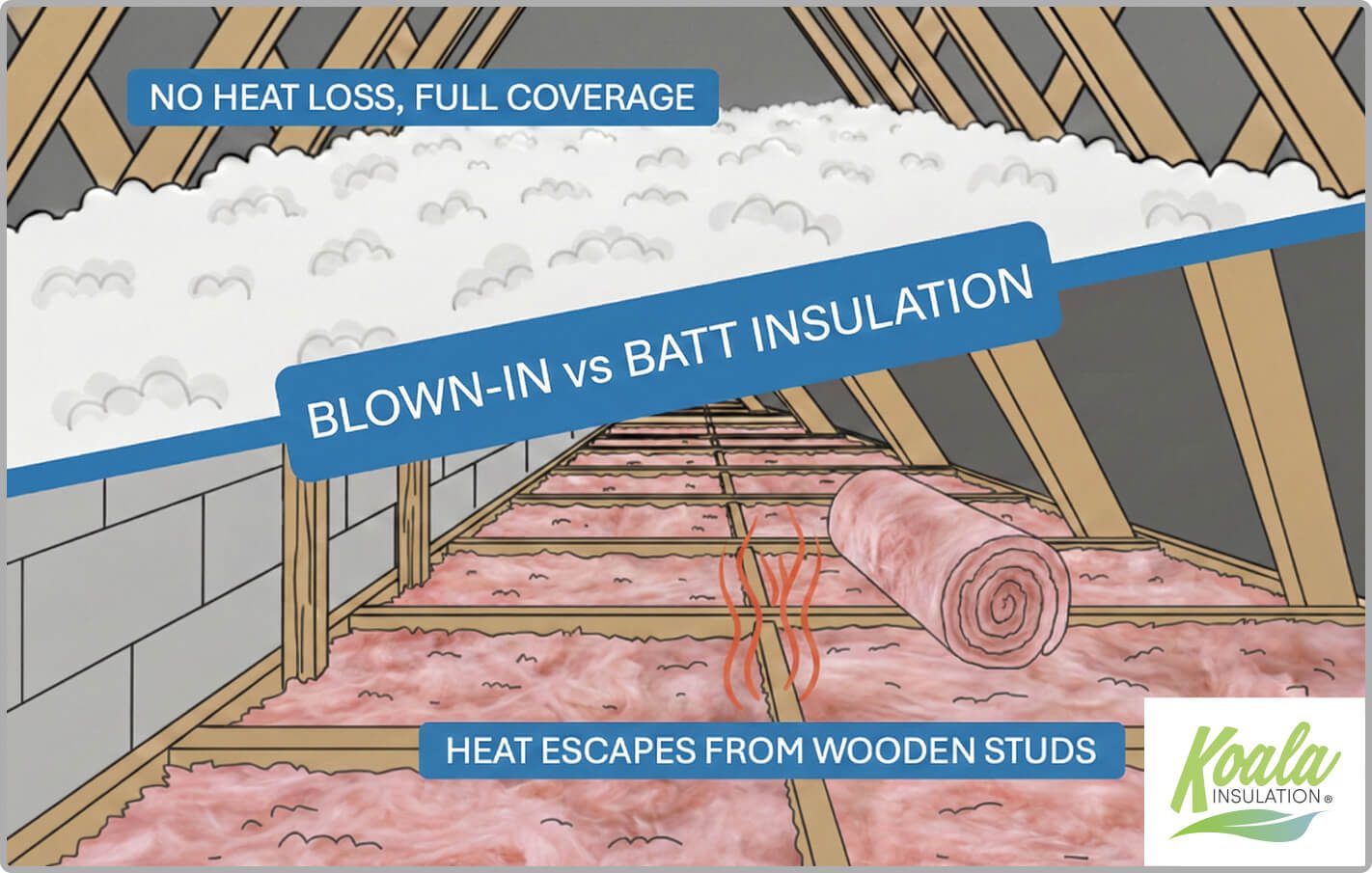
Is Blown-in Insulation Better Than Rolls?
In most attics in the Delaware Valley, yes. The advantage is coverage: blown-in material forms a seamless, continuous layer that conforms around framing, wiring, and plumbing, where rolls (batts) leave seams and voids. Small gaps sound trivial, but they translate into drafts, hot and cold rooms, and lower real-world R-value.
How Much Blown-In Insulation Does My Attic Need?
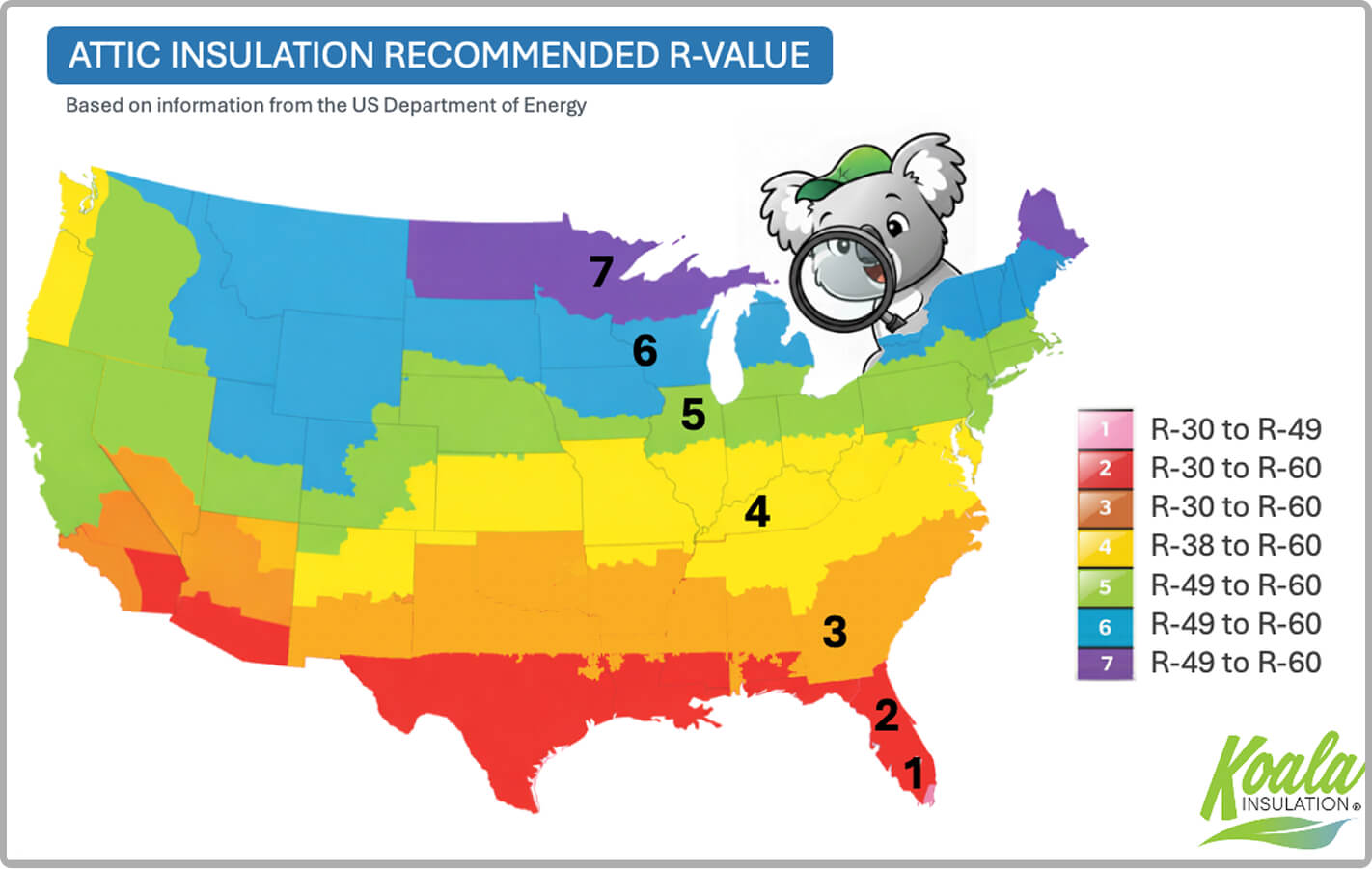
How much blown-in insulation you need depends on the size of the space, the insulation depth required, and your geographic location (see the map below). Climate plays a major role in determining the recommended R-value for an attic, with colder regions requiring thicker insulation to reduce heat loss and warmer regions needing enough insulation to block heat gain. The square footage of the attic and the target R-value together determine how much material is required to achieve consistent coverage. The Delaware Valley falls in IECC Climate Zone 4A (mixed-humid), where DOE and ENERGY STAR guidance calls for attic insulation of roughly R-38 to R-60.
Because insulation requirements vary by region, professional installers base material calculations on climate-zone guidelines, existing insulation levels, and manufacturer coverage charts rather than estimates. This ensures the insulation depth matches the recommended R-value for your area, accounts for natural settling, and avoids gaps that reduce performance. Check the diagram below to see how recommended attic levels change across regions, and why the right depth here is not the same as somewhere else.
Insulation Education
Learn why insulation is critical to your home’s energy efficiency and your family’s comfort.
Learn More
Get a quote
Ready to start your insulation project? Get a free quote from your local Koala Insulation team today.