
When Old Attic Insulation Has to Come Out: Rodents, Water and Mold in Phoenix East Valley Attics
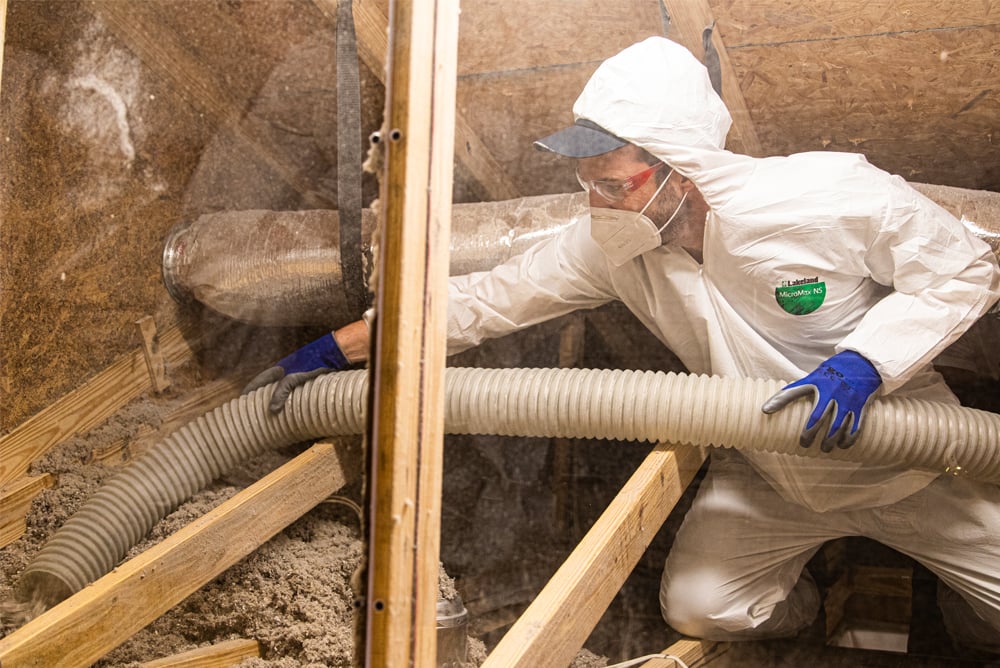
In most Phoenix East Valley attics, you add on top. You remove only when the old material is contaminated, wet or crushed.
That answer is going to save a lot of you a removal bill, and we’d rather say it plainly than let you assume otherwise. Removal is real work with a real price, and we do it. But it isn’t the default, and a contractor who tells you everything has to come out before they’ve been in your attic is selling, not diagnosing.
Ready to start your insulation project?
Here’s how to tell which situation you’re in, with a flashlight and twenty minutes.
First, the thing that fools almost everybody
You climb up, shine a light, and the insulation is grey, dusty and generally horrible looking. It looks like something that should be thrown away.
It usually shouldn’t. ENERGY STAR puts it about as directly as a government program can: “Although the insulation is dirty, it is still okay to use. There is no need to remove and replace it.”
The insulation didn’t stop working because it got dirty. Fiberglass and cellulose slow heat by trapping air in little pockets, and dust sitting on top doesn’t change that.
Better still, those dark patches are telling you something useful. ENERGY STAR again: “Look for areas where the insulation is darkened. This is the result of filtering dusty air from the house.”
Read that twice, because it’s the most valuable sentence in this article. The insulation went grey because air is moving through it. Your ceiling is leaking, and the dirt is a map of exactly where. Around can lights, at the top plates where walls meet the attic, around the bath fan, at the attic hatch.
So the grey patch isn’t a reason to haul everything out. It’s a reason to seal the ceiling before you add anything on top. Which, conveniently, is the order ENERGY STAR recommends anyway: “EPA recommends that you complete the attic insulation project after this project.” Seal first, insulate second.
The five conditions that actually mean removal
Now the other side. These are the situations where adding new insulation on top is genuinely the wrong move, and where we will tell you the attic needs clearing first.
1. Rodents have been living in it
This is the Phoenix Valley’s version of the problem, and it looks different here than it does in the guides written for Michigan basements. Our rodents are pack rats and roof rats. Pack rats build middens, which are big untidy nests of twigs, cactus segments and anything shiny they’ve collected. Roof rats travel along block walls and citrus and get in at the roofline, which is why older Tempe, Mesa and Ahwatukee neighborhoods with mature landscaping see them more than new builds in Eastmark do.
What you’re looking for from the hatch: tunnels and runways through the insulation, droppings concentrated in corners and along joists, shredded nesting material, and a smell you will not mistake for anything else.
Contaminated insulation comes out. It can’t be cleaned in place and it can’t be covered, because urine and droppings are in the material itself. The CDC’s guidance on cleaning up after rodents is worth knowing even if you never touch it yourself: air the space out “for at least 30 minutes” first, “wear rubber, latex, or vinyl gloves,” and “spray urine and droppings with bleach solution or an EPA-registered disinfectant until very wet” rather than dealing with it dry. That last part is the bit people get wrong. This is not a shop-vac job.
We do this work. We remove the contaminated material, then sanitize and deodorize the area before anything new goes in. One thing we don’t do, and nobody should: we don’t touch the rodents. Get pest control to close up the entry points first, or you’ll be paying for the same job again next year.
2. It’s wet, or it has been
Wet insulation is done. It compresses, it stays compressed, and it holds water against your framing.
In the desert this almost never comes from weather. It comes from a roof leak, or from an air conditioner. Attic-mounted AC units and their condensate lines are the usual suspects here, and a slow drip from a clogged condensate line can soak a patch of insulation for a whole summer without anyone noticing. Monsoon season finds every roof flaw we have.
ENERGY STAR’s own stop-and-get-help list includes “wet or damp insulation, indicating a leaky roof.” The insulation is the symptom. Fix the leak first, or you’re just buying wet insulation twice.
3. There’s mold
Same root cause, further along. ENERGY STAR lists “moldy or rotted attic rafters or floor joists” as a reason to stop and call somebody.
Moldy insulation comes out, and we remove it. But the honest division of labor is this: we can take out the material and clean up after it. We can’t tell you why your attic was wet in the first place. That’s a roofer or a plumber, and it has to be answered before new insulation goes in.
4. It’s crushed flat
Insulation works by holding air. Squash it and you lose most of what you paid for, permanently, because it doesn’t spring back.
Look for the places people walk: the path from the hatch, around the AC unit, anywhere somebody has run a wire. Also look for insulation that’s been used as storage shelving. And after thirty or forty years, blown-in material settles on its own.
Compressed insulation isn’t a health problem, so this one’s a judgment call rather than a rule. If it’s compressed in patches, you top up. If the whole attic has settled to a couple of inches, you’re usually better off starting clean, and our comparison of blown-in, spray foam and batt covers what to put back.
5. You’re moving the insulation to the roof deck
This one is about the new material, not the old one. If you’re switching to spray foam applied at the roof deck, the insulation on the attic floor is normally cleared out first, because the foam needs a clean surface to bond to and because the job moves your home’s insulated boundary from the ceiling up to the roof. Leaving the old material in place underneath usually isn’t the plan.
Worth asking about before you compare quotes, because it’s a real cost difference between two options that otherwise look similar on paper.
The one thing to stop and not touch
If you see a loose, pebbly, greyish-brown material that looks like tiny accordion-shaped pellets, stop.
That may be vermiculite, and ENERGY STAR’s instruction is unambiguous: “Some attics have vermiculite insulation, which may contain asbestos. Do not disturb vermiculite insulation unless you have had it tested.”
Don’t move it, don’t vacuum it, don’t let anybody blow new insulation over it until it’s been tested. If it does contain asbestos, that’s a job for an accredited asbestos abatement contractor, not an insulation company. We won’t touch it, and you should be suspicious of anyone who offers to.
The same page flags “knob and tube wiring (pre-1930), which can be a fire hazard.” Rare in Phoenix cities given when most of our housing stock went up, but worth a look in the older pockets of Mesa and central Tempe.
Your twenty-minute check
Open the hatch on a cool morning, not at two in the afternoon in July, unless you enjoy finding out what 160 degrees feels like. Take a flashlight and a tape measure, stay on the joists, and look for:
- Droppings, runways or nesting material. Contamination means removal.
- Dark or matted patches. Usually air leaks, not damage. Note where they are.
- Stains on the underside of the roof deck, or damp material. Find the water before you buy insulation.
- Anything growing on the rafters. Stop and get it looked at.
- Depth against the joists. If insulation is level with the joist tops or below, you’re short regardless of condition.
- Loose pebbly pellets. Possible vermiculite. Close the hatch.
If none of the first four apply, you almost certainly don’t need removal. You need air sealing and more depth, and how much more is covered in our guide to what attic insulation costs here.
What it costs, and why we’re not answering that here
Removal pricing is its own subject with its own honest answer, and we wrote it up separately rather than jam a number into this page. If you’ve worked out that your attic does need clearing, what insulation removal actually costs in the Phoenix East Valley is the next thing to read.
What we’ll say here is that removal and reinsulation are usually quoted together, and a quote that covers only one of them is hard to compare against one that covers both.
Questions we get
Can I just lay new insulation over the old?
In most Phoenix East Valley attics, yes. If the existing material is dry, uncontaminated and not crushed flat, adding on top is normal practice and it’s what ENERGY STAR recommends. Air seal first, then add depth.
Is 30-year-old insulation still good?
Age by itself doesn’t ruin insulation, and fiberglass and cellulose don’t expire. What thirty years does is give the material time to settle, get walked on, and collect whatever the attic has been through, which makes old insulation more likely to be compressed or contaminated. Judge it on depth and condition, not on the date the house was built.
How can I safely remove old insulation myself?
The clean, dry, non-contaminated version is a bad weekend and a rented vacuum. It’s legal, it’s possible, and plenty of people do it. Where we’d push back is anything involving rodent contamination or suspected vermiculite. The first needs containment so you aren’t moving the contamination into your living space, and the second needs testing before anything is disturbed at all. If you’re doing it yourself anyway, go early in the morning, wear a respirator rather than a dust mask, and stay on the joists.
Do I need pest control before you’ll do the work?
For an active infestation, yes. We can clear and sanitize a contaminated attic, but if the entry points are still open the new insulation is just a fresh nest. Exclusion works first, then us.
Getting it looked at
If your attic has any of the five conditions above, or you got up there and genuinely couldn’t tell, that’s what an evaluation is for. We’ll go up, tell you which of these you actually have, and give you a straight answer about whether anything needs to come out. Quite often the answer is no.
Koala Insulation of The East Valley is locally owned by brothers Bill and Jim Villani, based in Chandler and serving Phoenix, Mesa, Gilbert, Tempe, Queen Creek, San Tan Valley and Ahwatukee. AZ ROC #346944, SRP approved contractor, and our work is backed by the Koala Insulation Limited Lifetime Guarantee.
Evaluations are free. Call (480) 900-7274, or read up first on insulation removal and blown-in attic insulation. And if the reason you’re up in the attic is that one room never cools down, start with why your upstairs is so hot instead.
Last verified: September 23, 2026
Find Your Location



Get a quote