
What Does Insulation Removal Cost in the Phoenix East Valley?
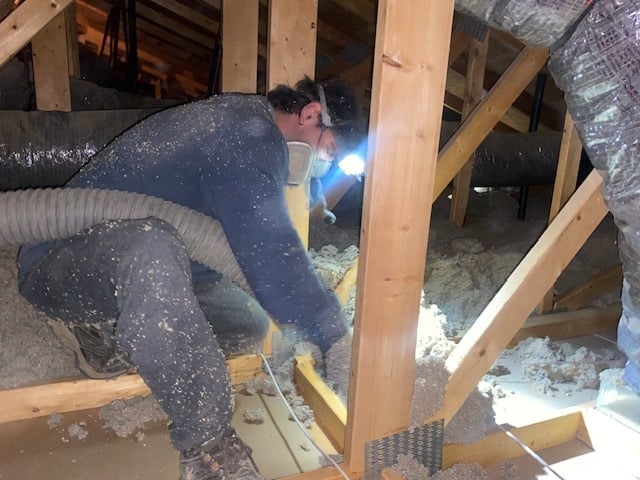
Search this question and you’ll find prices from about $600 to nearly $11,000. Both numbers are real. They’re answers to three different questions, and nobody bothers to say which one they’re answering. Before you pay for any of it, here’s the part a removal company isn’t supposed to tell you: unless your old insulation is wet, moldy, smelly, or full of animal waste, it can usually stay right where it is.
That isn’t us being modest. That’s ENERGY STAR, which puts it plainly: contractors can just add new insulation on top, and removing what’s already there is usually not necessary.
So let’s do this in the right order. First, why are the published prices all over the map? Then, how to tell whether your attic is one of the ones that genuinely needs clearing. Then what actually moves the number on a quote.
Ready to start your insulation project?
Why the prices you found disagree by ten times
We pulled the top results for “insulation removal cost” on September 8, 2026 and lined up what they said. Angi and HomeAdvisor both land on roughly $600 to $1,200 for the job. Yelp’s cost page runs about $0.75 to $2.25 per square foot, or somewhere near $800 to $1,700 for a typical attic. A handful of industry and contractor pages cluster tightly around $1 to $2 per square foot. Crawl Pros stretches that to about $1.50 to $3. And HomeGuide, at the far end, publishes $2 to $6 per square foot, or $3,200 to $10,800.
Every one of those is a national figure. None of them is a Phoenix number, and you should treat all of them as a starting point for questions rather than a quote.
Here’s the thing though. Those pages aren’t really contradicting each other. They’re answering three separate questions under one headline.
Removal only means vacuum the old material out, bag it, haul it away, leave the attic empty. That’s the cheap end of the published ranges. It’s also the job a homeowner almost never actually buys, because an empty attic in Arizona is worse than a badly insulated one.
Then there’s removal plus new insulation, which is what most people are really pricing when they start searching. That’s where the big range comes from, and the removal is one line on a larger invoice.
Different again is cleanup after contamination, whether that’s rodents, smoke or water. Sanitizing and deodorizing the deck after the material is out is real work, and it gets priced as such.
Read those three as if they were one number and of course you end up confused. It’s why the top organic result on this search is a Reddit thread and the second is a contractors’ Facebook group arguing about what to charge. The published answers weren’t usable, so people went and asked strangers.
One more trap worth naming. At least one cost calculator ranking on this search is quoting insulation installation prices, not removal, without making that obvious. If a per-square-foot figure looks high, check which job it’s describing.
Does your attic actually need to be cleared?
ENERGY STAR publishes a list of attic conditions that mean you should get a professional involved before anything else happens. It’s the closest thing to a free diagnostic you’ll find, and it works whether or not you ever call us.
You want someone up there if the insulation is wet or damp, which points to a roof leak. Same if you can see mold, or rot in the rafters or joists. Same if a bathroom fan, kitchen vent, or dryer duct is dumping moist air into the attic instead of outside, which is more common in Phoenix Valley homes than you’d hope. Same if there’s little or no attic ventilation. And same if the house is from the 1930s or earlier and still has knob-and-tube wiring, which is a fire risk in contact with insulation.
If none of that describes your attic, the honest answer is that you probably don’t need removal. You need more insulation on top of what’s there, and possibly air sealing first.
You can check the depth yourself in about five minutes. Look across the attic floor. If the insulation is level with the joists or below them, there isn’t enough of it. To estimate what you’ve got, measure the depth in inches and multiply by three, since most common materials land around R-3 to R-3.5 per inch. ENERGY STAR’s retrofit table for our climate zone calls for R-49 when an attic has nothing in it, and R-38 when it already has three or four inches. Topping up to that with blown-in attic insulation is a smaller, cheaper job than clearing the attic first.
One rule to hold your contractor to, and it’s ENERGY STAR’s, not ours: the gaps and holes in the attic floor get sealed before any new insulation goes down.
The four reasons Phoenix East Valley attics really do get emptied
Removal isn’t rare here. It just has specific causes, and they’re local ones.
Rodents. Pack rats and roof rats get into attics across Chandler, Gilbert and Mesa, and once there’s nesting and waste in the insulation, that material is done. Sanitizing around it isn’t an option. It comes out, the deck gets cleaned and deodorized, then new material goes in.
Blown-in that’s simply old. A lot of Phoenix East Valley housing stock is now twenty to thirty years past its build date. Loose-fill settles over that time, and settled material sitting below the joists isn’t doing much except taking up the space new insulation should occupy. If it’s also dusty, compacted, and full of monsoon grit, clearing it is usually the better call.
Smoke and fire damage. Insulation holds odor, and once smoke is in it there’s no cleaning it out. It has to come out instead.
Clearing the deck before solar. If you’re adding panels and want attic work done anyway, doing the insulation while the attic is accessible and before the roof gets busy saves you a second mobilization. Worth sequencing deliberately rather than by accident.
Crawl spaces are a separate conversation with their own considerations, and we handle those under crawl space services.
What actually moves the number on your quote
Square footage is the starting point, not the answer. What changes the price from there is mostly about how hard the attic is to work in.
Access matters most. A pull-down stair in a hallway is a different job from a small hatch in a closet ceiling. Roof pitch and headroom matter, because a crew that can stand up works faster than a crew crawling on their stomachs over trusses. The material matters too, since loose-fill vacuums out while batts have to be handled by hand, and depth compounds either one.
Contamination adds sanitizing and deodorizing work on top of the removal itself. And something people never think about, the distance from the attic hatch to where the truck can park, which decides how far every bag of old material gets carried.
The biggest factor, though, is whether removal is standing alone or is step one of a re-insulation job. Bundled into a full removal and replacement, the crew is already there, already set up, already handling material. The marginal cost of the removal is lower than any standalone quote you’ll find. That’s the comparison worth making, and it’s the one none of those national cost pages sets up for you.
The one job we’ll tell you to give someone else
If your attic has vermiculite, which is a pebbly, gray-brown, accordion-looking material found in some older homes, stop. Don’t disturb it, and don’t let us or anyone else vacuum it out.
The EPA advises assuming vermiculite insulation may contain asbestos and leaving it undisturbed. If it does have to be removed, the agency says the work belongs to a trained and accredited asbestos abatement contractor, and specifically one that’s independent of whoever assessed it. EPA also strongly recommends against removing it yourself.
That’s not our license and it isn’t our trade. We’ll tell you what we think you’re looking at and point you toward the right people.
Questions we get asked
How much does it cost to get insulation removed?
Nationally, published ranges run from roughly $1 to $3 per square foot for straightforward removal, and higher when there’s contamination to clean up. We don’t publish a Phoenix Valley number because the honest answer depends on access, material and depth, and any company quoting you before they’ve seen your attic is guessing.
How long does it take to remove insulation from an attic?
Most single-family attics here are a one-day job. A tight hatch, a low pitch, or heavy contamination can stretch it. If a crew tells you two hours before they’ve been up there, be skeptical.
Can I remove insulation in an attic by myself?
Physically, sometimes. It’s hot, filthy work in a space where stepping off a joist puts your leg through the ceiling, and in a Phoenix summer an attic is not a place to spend an afternoon learning that. The bigger issue is that DIY removal without proper containment spreads whatever was up there through the house, which matters a great deal if the reason you’re removing it is rodents or smoke. And if there’s any chance the material is vermiculite, the answer is a flat no.
How much does it cost to insulate a 1,600 square foot house?
That’s a different question from this one, and a good one. Attic square footage, existing R-value and material choice all drive it. Ask for it as a separate line on your quote so you can see what you’re paying for removal and what you’re paying for insulation.
Get a straight answer about your attic
Bill and Jim Villani run Koala Insulation of The East Valley out of Chandler, and we serve Phoenix, Mesa, Gilbert, Chandler and Tempe and surrounding cities. If your attic doesn’t need clearing, we’ll say so. If it does, you’ll get a written number with the removal and the new insulation broken out separately, so you can see exactly what each part costs.
Call (480) 900-7274 or request a free insulation evaluation. We’re licensed in Arizona under AZ ROC #346944, we’re an SRP approved contractor, and our work is backed by the Koala Insulation Limited Lifetime Guarantee.
Not sure which service you need? Start with our East Valley services overview.
Find Your Location



Get a quote