
Why Is My Upstairs So Hot? The Phoenix Two-Story Problem
Almost every answer to this question starts with “hot air rises.” That is true, and in a Valley two-story it is close to the least important thing happening. The heat making your upstairs miserable in August is mostly coming down through your ceiling from an attic that has been absorbing sun since ten in the morning. Once you know that, the list of things worth doing changes completely.
Here is the ranked version for the house this actually happens to: a two-story built in the Phoenix East Valley in the 2000s, with the air handler and most of the ductwork sitting up in that attic.
Ready to start your insulation project?
Why “heat rises” is the wrong diagnosis here
The stack effect is real. Warm air in your house does drift upward, and on a mild evening in a mild climate that is most of the story.
It is not most of the story here, and the Department of Energy’s building science explains why. In its guidance, DOE notes that most of the heat transfer from the roof down to the attic floor is radiant rather than convective. The roof deck gets hot, and it radiates that heat across the attic to whatever is below it, which is your insulation and then your ceiling.
Radiant heat does not care which way is up. It does not need moving air to carry it, and why a bigger air conditioner treats a symptom rather than a cause. Your upstairs is not hot because warm air from the kitchen climbed the stairs. It is hot because there is a very large warm surface directly above it and not much in between.
That single distinction is why an HVAC answer and an insulation answer to this question look so different.
The five causes, ranked for this house
Each of these has a test you can run today, mostly without tools.
1. Not enough insulation on the attic floor
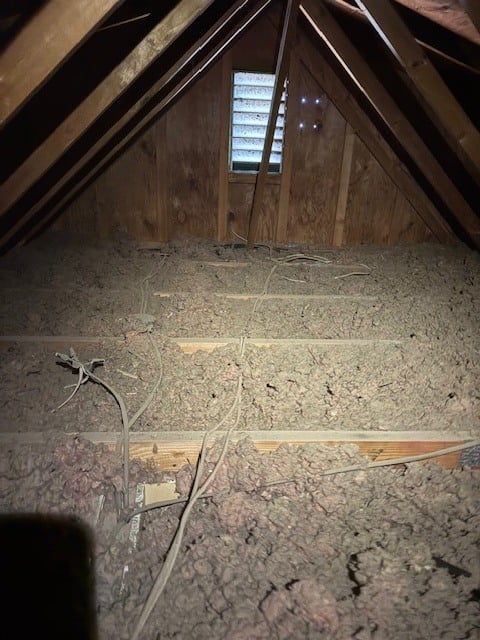
This is first because it is the most common and because it sits directly in the path described above. The Phoenix East Valley is in climate zone 2B, and current DOE and ENERGY STAR guidance for attics in this zone runs roughly R-38 to R-49. A lot of houses built here in the 2000s were insulated to the standard of their day, and then the material settled, drifted, got walked on, and had storage boxes pressed into it.
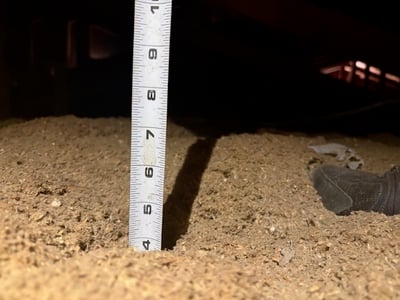
How to tell if this is yours: put your head in the attic hatch with a tape measure. Blown fiberglass or cellulose that is level with or below the ceiling joists is not doing much. You want to see material well above the joists, evenly, all the way to the edges. If you can see the tops of the joists across the whole attic, you have found your problem.
2. Ductwork running through a superheated attic
In most two-story homes here, the ducts serving upstairs run through the hottest part of the building. Air that left the coil cold picks up heat on the way, and if those ducts leak, some of it never arrives at all. DOE puts sealing and insulating attic ductwork second on its own list of what to do when an attic runs hot, right after the ceiling.
How to tell if this is yours: hold your hand at an upstairs register with the system running hard. You are feeling for cold, not just movement. Air that is moving but merely cool, especially at the register furthest from the air handler, points at the duct run. Compare it against a downstairs register.
3. Nothing sealing the ceiling plane
Insulation slows heat. It does not stop air. Every can light, plumbing penetration, bath fan, top plate and attic hatch is a hole between your conditioned rooms and that attic, and insulation laid over the top of a hole does not close it.
How to tell if this is yours: stand in an upstairs room on a hot afternoon with the lights off and look at the can lights and the attic hatch. Dust streaks on nearby ceiling paint are a giveaway, since moving air leaves marks. The hatch itself is the easiest one to check: if it is a sheet of plywood dropped into a frame with no gasket and no insulation on top, it is a hole.
4. Not enough return air upstairs
Supply is only half a system. If the upstairs cannot get air back to the air handler, the whole floor fights itself, and individual rooms with the door shut fight hardest.
How to tell if this is yours: close a hot bedroom’s door for an hour on a bad afternoon and see whether it gets noticeably worse than the hallway outside it. If it does, that room cannot return air.
This one is not our work, and we will not pretend otherwise. Return sizing, duct sizing and equipment capacity are HVAC jobs, and anyone who tells you insulation fixes a return-air problem is selling you insulation. We will tell you if we see it, and then you want a mechanical contractor.
5. West-facing glass
Last on the list because it is real, obvious, and usually the smallest of the five. Afternoon sun through unshaded west glazing puts heat directly into a room during the hours it is already losing the fight.
How to tell if this is yours: the worst room faces the sunset, and it is worse between about four and seven rather than at midday. Shade, film and coverings all help, and none of them address the ceiling above the room.
The order to fix them in, according to DOE
We are not asking you to take our word for the sequence. When DOE’s Building America Solution Center addresses an attic that runs too hot, its stated best practices run in this order: increase insulation and air seal the ceiling deck; air seal and insulate the attic ductwork; improve ventilation by clearing airflow obstructions such as insulation blocking the eaves.
Insulation and ceiling air sealing come first. That happens to be our work, which is exactly why it is worth pointing out that we did not decide the order. A federal building science program did, and the reason is the one from the top of this article: you are fighting radiant gain through a surface, so the surface is where you start.
In practice, on this housing stock, that means topping the attic up to depth and sealing the ceiling plane as one job rather than two. Doing either alone leaves most of the benefits on the table, which is why we quote them together.
What we would not do first
A bigger air conditioner. More capacity will move the temperature. It will also run harder, longer, against a load nobody reduced. If the ceiling is the leak, upsizing the equipment is paying monthly to keep pace with it.
This does not mean never, it means not first.
Questions we get
Is it normal for upstairs to be hotter? Some difference is normal anywhere. A second floor that is uncomfortable while the downstairs thermostat reads fine is not normal, it is a symptom, and in a Phoenix Valley home it is usually the ceiling.
How do I cool down upstairs without replacing the AC? Deal with the attic floor first: insulation to depth, ceiling penetrations sealed, eave intake clear. Then have the attic ductwork checked. Most homes here get most of the improvement from those two steps, and they are permanent rather than something you run.
Why is my upstairs hot at night, hours after sunset? This is the clearest sign that the mechanism is radiant rather than air movement. The roof and the attic hold heat well after the sun is off them and keep radiating it downward for hours. Air-based fixes do very little about stored heat. Insulation does.
Why is my upstairs hot in winter too? Usually a different cause wearing the same clothes, and it is normally airflow balance or thermostat location rather than the attic. Worth mentioning to an HVAC contractor rather than to us.
Will more insulation alone fix it? Often, largely, yes, when the attic is genuinely underinsulated and the ceiling gets sealed at the same time. Not always. If your ducts leak into the attic or the upstairs cannot return air, insulation improves things without finishing the job. We would rather tell you that at the evaluation than after the invoice.
Find out which one it is
We will go into your attic, measure what is actually up there, check whether your eave intake is clear, look at the condition of the ductwork, and tell you which of the five above is driving your problem. If the honest answer is that your insulation is fine and you need a mechanical contractor, that is what you will hear, and it will not cost you anything to hear it.
Koala Insulation of The East Valley is locally owned by Bill and Jim Villani, based in Chandler, licensed under AZ ROC #346944, and an SRP approved contractor. We serve, Gilbert, Chandler, Tempe, Mesa and surrounding Phoenix cities. Every job is backed by the Koala Insulation Limited Lifetime Guarantee. You can see everything we do across the Phoenix East Valley, or read why homeowners here choose us.
Call (480) 900-7274 or request a free evaluation.
Find Your Location



Get a quote